Harpist Kondonassis provides the colorful highlight of Fairfax Symphony program
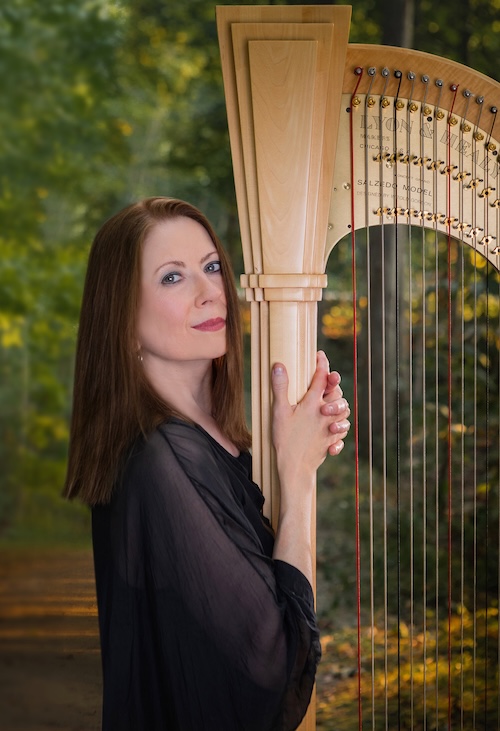
Yolanda Kondonassis performed Ginastera’s Harp Concerto with the Fairfax Symphony Orchestra Saturday night. Photo: Laura Watilo Blake
The Fairfax Symphony Orchestra treated its audience to an exciting, varied program Saturday evening at the GMU Center for the Arts led by music director Christopher Zimmerman. New and old works sandwiched a rare concerto for harp, making for a unique concert that jolted listeners in the first half and calmed them in the second.
The program opened with a world premiere entitled Fanfare for a Runaway Prince, composed for the Fairfax Symphony by Adam Hochstatter. This followed the orchestra’s regional premiere of the film and video game composer’s saxophone concerto last month.
Fitting the piece’s title, the Fanfare opened with bright, bold brass that set a lively tone before transitioning to a capricious dialogue between winds and strings. A full percussion section added interest with mallets, drums, and cymbals. Moments of differentiated instrument groupings helped to break up the work as it chugged along, including soaring solos for horn and trumpet and strings sweetened with piccolo. While the piece seemed to rapidly jump from one idea to the next, Zimmerman built effectively to a big finale with a sweeping full-orchestra crescendo.
The orchestra was joined by soloist Yolanda Kondonassis, who took center stage for Alberto Ginastera’s virtuosic Harp Concerto. Her performance was captivating, making rapidly plucked melodies and arpeggios appear effortless and producing a huge range of sound colors and textures. The first movement saw the harp’s melody in octaves driven forward by pulsing strings and winds, with similarly sharp articulation, even having Kondonassis tapping out the beat on her harp’s soundboard.
Balancing orchestra with a soloist is always a challenge, especially with a softer-toned instrument like harp; unfortunately the soloist was at times drowned out by the orchestra’s accompaniment.
Luckily Ginastera writes plentiful lightly scored sections to let the harpist truly shine, as in the slower second movement with its supporting solo winds and dissonant, airy string chords. Kondonassis’s dynamics ranged from a whispering piano to full, resonant forte.
The third movement opened with an extended cadenza, which featured every technique and then some: ethereal harmonics, plucking près de la table for a guitar-like sound, sparkling bisbigliando, bending pitches mid-note with pedal changes, and sweeping full-instrument glissandi, all of which made this section practically a standalone piece in itself and a highlight of the concert. The cadenza was followed by an energetic finale, which incorporated Ginastera’s interest in folk music into its melodies with a large Latin percussion section.
The second half of the concert was dedicated entirely to Beethoven’s Symphony no. 6 “Pastoral,” a welcome escape from the gloom of a chilly November weekend.
Zimmerman conducted at a brisk but never frantic pace, keeping the piece moving through its relaxed opening movements and not letting his orchestra drag even when they sometimes seemed reluctant to keep up. The first movement, minus its repeat, was sweet and sunny, though the violins had a brief moment of unsteadiness during the transition to the development.
The second movement (“Scene by the brook”) kept up a comfortable tempo on the quick side. Lower strings were more precise with their pizzicati then their bowed sections. Principal winds relished the many solo moments gifted to them by Beethoven, especially the closing birdsong by Larry Ink, flute, Emily Snyder, oboe, and Patrick Morgan, clarinet.
The rustic third movement was somewhat reserved in character, not quite reaching the peak of its raucous potential, though coming close with the strong string accents and entry of the brass at the meter change. The orchestra transitioned seamlessly into the stormy fourth movement. Jonathan Milke’s booming timpani and the furiously rumbling cellos and basses brought thunder to the scene, and piccolo Sharon Lee complimented the melody without sounding shrill.
The orchestra settled into an easygoing but still mobile finale, ushered in with the shepherd calls by principal clarinet and horn (Nat Willson). Zimmerman’s full-body conducting smoothly guided the orchestra to its conclusion, with the whole ensemble staying perfectly together through the final rallentando.
The Fairfax Symphony welcomes Michael W. Smith to present his Every Christmas concert tour at 7 p.m. December 14 at Capital One Hall Tysons. fairfaxsymphony.org
Leave a Comment