Fairfax Symphony opens season with a bracing double shot of premieres
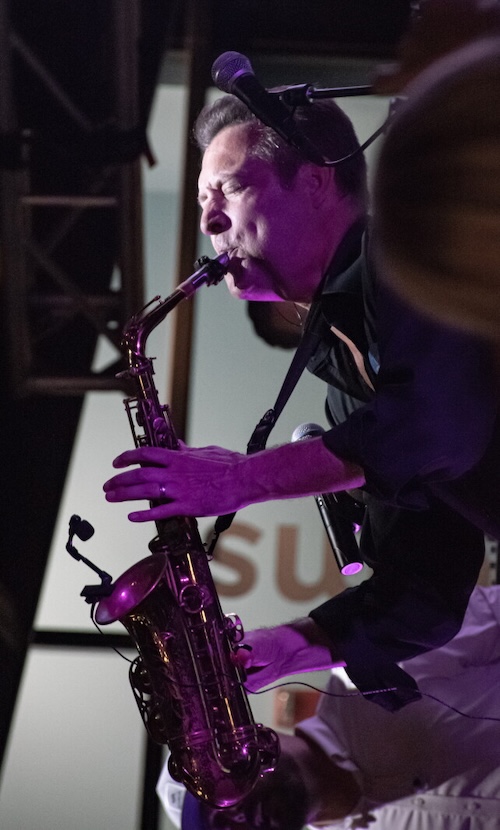
Saxophonist Russell Peterson performed Adam Hochstatter’s Noir Concerto No. 1 with the Fairfax Symphony Orchestra Saturday night. File, photo: W. Scott Olsen
The Fairfax Symphony Orchestra, and its music director Christopher Zimmerman, have always embraced contemporary music. Yet for their season opener Saturday night at the Center for the Arts at George Mason University, Zimmerman and the orchestra upped the ante.
The program brought both the world premiere of Jonathan Leshnoff’s orchestral arrangement of his piano quintet Radiance and the regional premiere of Adam Hochstatter’s Noir Concerto No. 1 for saxophone and orchestra, with soloist Russell Peterson.
Leshnoff completed the quintet in 2013, following a commission from Emily Tarsell in memory of her daughter Christina, who died suddenly at the age of 28 in 2008. The elder Tarsell was in the audience Saturday to hear the work in orchestral garb.
Radiance begins with a fast, rising figure that spreads out and shimmers across the music, its development suggesting a person with a full life zooming from interest to interest. A long pause introduces a slow, elegiac section, after which the faster music returns, refracted into something darker; the succeeding elegiac section, by contrast, eventually wrings light from somber harmonies. Although at times there seems to be a void in Radiance where a memorable theme should go, the piece nevertheless makes an affecting memorial.
Leshnoff’s transcription expands the sonorities of the original (which you can hear here), but some of the visceral immediacy of the quintet version was lost, and it was hard to identify any striking instrumentation choices in the transcription. After a few synchronization problems early on, the Fairfax players gave it their all, with the strings particularly eloquent in the second slow section.
Hochstatter is best known for his work on movie and TV soundtracks, contributing to such films as Spider-Man 2 and Escape from the Planet of the Apes. He wrote the Noir Concerto No. 1 for Peterson, his teacher at Concordia College in Moorhead, Minnesota, and it received its world premiere with Peterson and the Fargo-Moorhead Symphony last fall, under Zimmerman’s baton.
Hochstatter’s concerto draws on the bluesy, jazzy feel of many film noir soundtracks and follows an imagined scenario of “a young detective starting his new life on the job.” Hochstatter conjured many memorable scenes — a yearning saxophone lick echoing over low strings and percussion, a syrupy but memorable love theme, an angular theme scampering ahead — but didn’t quite tie them together musically, or make them add up to more than the sum of their parts.
Peterson was the ace in the hole on Saturday. He seems to know everything there is to know about playing the sax — his breath control, tone, and fingering were all superlative, and he shifted fluently from blues to jazz to classical as the moment demanded. More crucially for this concerto, he used his technique to make his solo part into a dramatic character, creating a through-line that maintained interest. Zimmerman drew fine support from the orchestra, augmented with a battery of jazz percussion for the occasion.
Ultimately, Hochstatter’s debut entry into the concerto genre has many fun moments, and perhaps more cohesion will come with future efforts.
After the concerto performance, the house lights were dimmed and the orchestra members began leaving the stage. But it was all a feint, as Peterson emerged from the wing in a spotlight, playing a scorching jazz solo on one of the themes from Hochstatter’s concerto. The encore brought the house down, deservedly so.
The concert concluded with Sergei Rachmaninoff’s Symphony No. 3, completed in 1936. The first movement never quite cohered Saturday—there were brass flubs in the opening bars and occasional lack of synchronization across the large forces the symphony requires, although the closing restatement of the melancholy opening theme had an eerie, halting tread.
That concentration carried over into the second movement, where the orchestra nailed the tricky transitions between slow movement and the embedded scherzo, maintaining an enigmatic atmosphere. This was Ryo Usami’s first concert as FSO concertmaster, as David Salness retired after 28 years in the position. Usami shone in this movement with some characterful solos.
The finale found the FSO at its best, with Zimmerman deftly managing Rachmaninoff’s frequent shifts in tone and rhythm and the orchestra playing beautifully. They fizzed in the fugato, dug into the inevitable “Dies Irae” quotations with gusto, and capped it all with brilliant fanfares — a fine ending to the start of the FSO season.
The Fairfax Symphony Orchestra plays music of Hochstatter, Ginastera and Beethoven November 14. fairfaxsymphony.org
Leave a Comment