Slatkin and Tower put spotlight on engaging new music with NSO
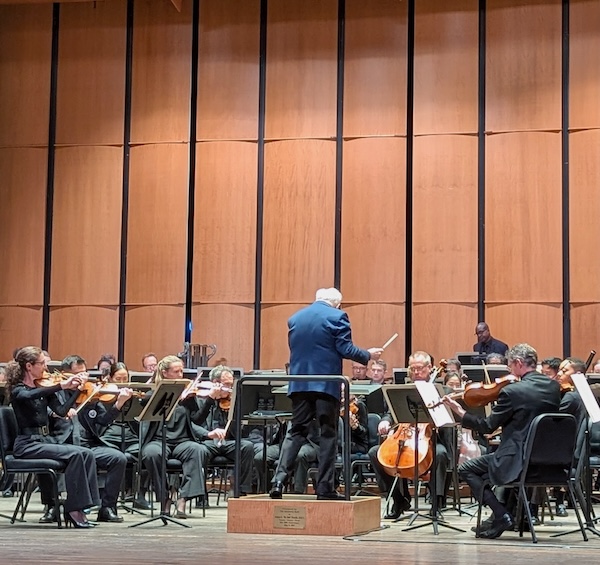
Leonard Slatkin conducted the National Symphony Orchestra Thursday night at Schlesinger Hall in Alexandria. Photo: C. Downey
Leonard Slatkin, the National Symphony Orchestra’s fifth music director, returned to conduct the ensemble Thursday night. Unlike his last visit in 2024, this time the podium was in Schlesinger Hall in Alexandria, rather than the Kennedy Center. Over the past two chaotic years, Slatkin has not kept quiet about the troubles facing his former home. Last night, he preferred to speak mostly about the music he was conducting.
Slatkin, 82, led the NSO from 1996 to 2008. At the start of this season, he began a new appointment, as music director of the Nashville Symphony. In another disastrous turn, his new band declared a fiscal emergency last month and abruptly canceled the rest of its season. The tech company Oracle, which is building a new headquarters in Nashville, saved the day with a $10 million gift two weeks ago, allowing the orchestra to rehire its musicians and salvage the season.
New works by American composers often enjoyed attention during Slatkin’s tenure here, a trend he continued with Love Returns, the new alto saxophone concerto by Joan Tower. This poignant piece, premiered at the Colorado Music Festival last year, is a set of variations on Tower’s brief piano work called Love Letter, dedicated to her late husband, Jeff Litfin. Saxophonist Steven Banks, who made his NSO debut in 2024, took the solo part as he did at the premiere.
The melody’s opening motif, ascending perfect fifths like the open strings of a violin, rose gently through the violin section. Banks took over the tune and then added numerous riffs on it and on the other sections of the melody. In the perky first variation, Banks easily held his own against the massed orchestra, as other ideas from the theme percolated by. Loud brass punctuated the ensuing agitated variation, which concluding with shimmering sounds.
Tower did not quite achieve a broad range of orchestral color in this piece as she did in her cello concerto A New Day, also dedicated to her husband. (The NSO played that outstanding piece in 2022.) This left most of the excitement to the vibrant, bold playing of Banks, as in the brief fifth variation given over to a saxophone cadenza. The final variation featured interesting use of percussion, like the sleigh bells that undergirded climaxes, often with searing high notes from Banks. This is a piece that more orchestras should play, like all of Tower’s music.
Tower, 88, who spoke movingly about the genesis of the work before the performance, returned to play an equally moving encore with Banks. She sat at the piano that was wheeled on the stage, to accompany the saxophonist in his own brief work, Of an Open Heart. The harmonic style borrowed colors from Debussy and Tower herself, a convincing sort of neoclassicism, mostly triads leavened with tinges of dissonance.
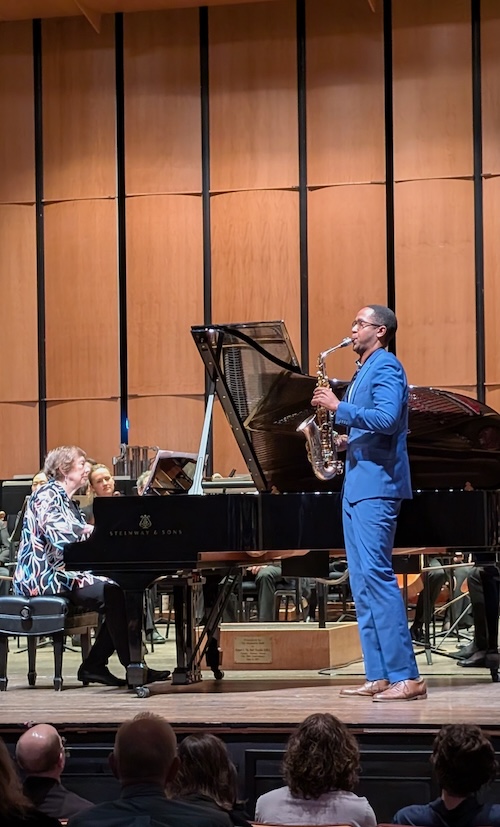
Saxophonist Steven Banks played an encore with composer-pianist Joan Tower at Thursday night’s NSO concert. Photo: C. Downey
Slatkin opened the concert with his own Schubertiade, a dramatic pastiche of Schubert’s music premiered in 2025. To the strains of Schubert’s Piano Sonata in B-flat Major, played by pianist Lisa Emenheiser, modern composers “arrived” to enjoy the entertainment, as Slatkin described it. Themes from the first movement of the “Unfinished” Symphony were woven into their noisy interruptions, including a minimalist tribute that began on woodblock and marimba. As these interlopers departed, more Schubert tributes popped up, including “Die Forelle” and the Fantasia in F Minor. The effect was enjoyable enough, if ultimately, not particularly memorable.
Far greater pleasures came in the second half with an excellent interpretation of Rachmaninoff’s Third Symphony, played earlier this month by the Fairfax Symphony Orchestra. Slatkin tends to bring out the less schmaltzy side of this composer, as he did with the rush of sound following the opening theme of the first movement. The amassed sound of the violin section in the more Hollywood sections proved luxuriant, and the cellos purred lusciously on the gentle second theme.
Principal horn player Abel Pereira gave a silken reading of the main theme of the second movement, to delicate harp accompaniment, taken over with romantic fervor by concertmaster Nurit Bar-Josef. The middle section, a Scherzo grafted onto the slow movement, scampered with admirable energy. Slatkin helped give a forceful edge to the third movement, adding a playful touch even to the dour fugue. Hints of the Dies Irae melody, one of Rachmaninoff’s favorite tropes, could not keep the ebullient conclusion down.
The program will be repeated 11:30 a.m. October 23 at Schlesinger Hall and 8 p.m. October 24 in the Music Center at Strathmore. nationalsymphony.org
Leave a Comment