Noseda rounds out first NSO season stand with uplifting Russian music
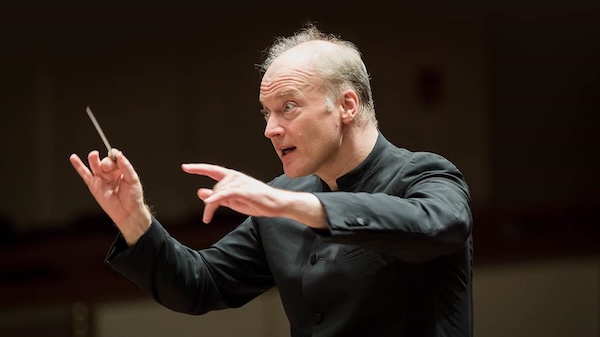
Gianandrea Noseda conducted the National Symphony Orchestra Thursday night at Schlesinger Hall in Alexandria.
Gianandrea Noseda put a spotlight on his expertise with Russian music for his first two subscription programs of the National Symphony Orchestra’s new season. After romantic fare by Rimsky-Korsakov and Mussorgsky last week, the Italian conductor proceeded to Stravinsky and Prokofiev Thursday night at Schlesinger Hall in Alexandria. In between came an elegant Haydn symphony, with just the right hint of expected twinkle in the composer’s eye.
Schlesinger Hall is smaller and the audience was sparser than the previous two weeks at Strathmore. Hopefully the “modern” program was not the cause, because the Russian pieces, both composed in 1944, are neoclassical and rather plush in harmony. Stravinsky, after moving to the United States, created his Scènes de Ballet, heard first, as part of a Broadway revue called The Seven Lively Arts at the Ziegfeld Theater.
After three weeks of hearing the NSO play in different halls, one gets the overwhelming impression that playing outside the Kennedy Center Concert Hall for two years is going to be a net positive for the orchestra. Their sound comes more easily to the listener’s ear, and they seem to be hearing each other in new ways as well. Noseda, for his part, drew out the many odd solo instrumental moments in this eccentric but charming score, carefully controlling the overall sound.
Passages for four solo violas, three solo violins, two solo cellos, and many others featured chamber-sized portions of the orchestra, all beautifully done. Assistant principal Jamie Roberts gave a buoyant clarity to the oboe solos, with some brief minor issues from the trumpet and horn. The closing of the “Apothéose” movement, which comes to rest on a C major chord with a clashing major seventh added, shimmered like vibrating lights.
Noseda should program more Haydn symphonies instead of concertos for the second position in this kind of program. His take on Symphony No. 96 in 2021 boded well for this rendition of Symphony No. 85, from 1785. The piece earned its subtitle (“La Reine”) because Marie Antoinette liked it the best of Haydn’s six Paris symphonies. Noseda and the musicians shaped the piece elegantly, a sound that was courtly in the best sense, well-mannered but not pompous.
Noseda’s tempo in the first movement, a bit frenetic at first, settled into place as the graceful Vivace theme appeared. In one of his typical inside jokes, Haydn quoted his own “Farewell” Symphony just before the secondary theme in this movement, an unexplained insertion that does not return in the recapitulation. Scholars have conjectured that this curious self-allusion may have caused the endearment of the piece to the French queen.
The second movement, a set of variations on a folk music-like tune, proved lively but delicate. Decorations by flute and bassoon in later variations featured clever embellishments as well, a bit of rococo lily-gilding that tickled the ear. The more propulsive take on the Menuetto lifted the chipper melody’s braying motif off the page. With dancing gestures, Noseda brought out the demure and more forthright facets of the finale as well.
Roderick Cox last conducted Prokofiev’s Fifth Symphony with the NSO, back in 2022. Noseda is in the midst of recording a highly regarded Prokofiev symphonic cycle with the London Symphony Orchestra, and he approached this reading of the Fifth with assertive confidence. The first movement, cut from the same cloth as the composer’s score for the ballet Cinderella of the same period, featured lush strings and sonorous woodwinds in epic strokes of sound. The coda, with rattling octaves from the piano, shivered with majesty and menace.
Offenbach-style mania took hold in the madcap second movement, boiling over with obsessive intensity in the accelerating conclusion. Exquisitely tuned playing in the ultra-high register for violins and woodwinds gave the third movement an ideal romantic swoon, with some blaring interjections from the brass.
The divisi cello section sweetened the opening of the Finale, which opened impatiently into a joyous galop, again recalling Offenbach at times. Noseda helped various sections of the orchestra lean into some dissonant, grumbling lines that dotted the landscape. These little details, added up, made the ending, in which the piece seems to go almost off the rails, much less of a surprise. With methodical intensity, Noseda ratcheted up the exciting conclusion notch by notch, with clattering percussion and growling trumpets.
The program will be repeated 11:30 a.m. Friday at Schlesinger Hall, and 8 p.m. Saturday in the Music Center at Strathmore. nationalsymphony.org
Leave a Comment