NSO begins forced political exile with “celebration” program at Strathmore
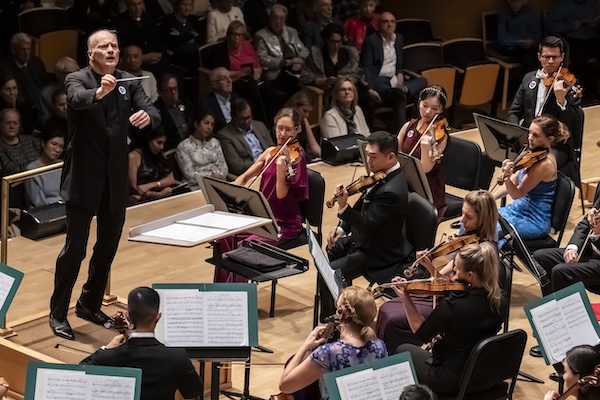
Gianandrea Noseda conducted the National Symphony Orchestra Saturday night at the Music Center at Strathmore. Photo: Scott Suchman
The National Symphony Orchestra has hit the road this season. The main building of the Kennedy Center remains closed to the public as of September 16. While the newer buildings of the Reach are still hosting concerts and other events, the NSO continues to rehearse in the Concert Hall, at least for now.
The NSO’s 96th classical season got underway Saturday evening, with a season-opening celebration concert in the Music Center at Strathmore. Most of the expected trappings of past season-opening galas returned, including the traditional playing of the national anthem. The musicians, dressed in evening gowns and tuxedos, took the stage only after the lights went down, this time earning a standing ovation before even playing a note. By comparison to previous years, speeches were brief, and the event was styled a “celebration” rather than a gala, reflecting the scaled-down dinner for donors that preceded the performance. No announcement about money raised was forthcoming.
Gianandrea Noseda embarked on his tenth season as music director with a program of unexpected repertoire instead of the usual crowd-drawing big-name soloist. Three suites reflected Noseda’s international career: Tchaikovsky’s Swan Lake for Russia, Carlos Simon’s new Monuments: A Suite for D.C. for America, and Respighi’s La boutique fantasque for Italy. The inclusion of two ballet suites seemed to silently acknowledge the KC closure’s devastating impact on visits to Washington from major ballet companies, as well as on the NSO.
Tchaikovsky himself did not put together the suite from his music for Swan Lake, and the choice of movements was ordered more for musical contrast and effectiveness than a linear dramatic arc. In the opening “Scène” (music from Act II), principal oboist Nicholas Stovall gave a delicate, forlorn poignancy to the famous swan theme. The full orchestra added tragic heft, at its fullest booming with well-coordinated brass support. (Evan Williams is serving as acting principal trombonist this season, after Craig Mulcahy became principal of the Atlanta Symphony Orchestra at the end of last season. Seth Carter also began his tenure as principal tuba.)
The NSO displayed pleasing expressive range in the “Valse” music from the Act I birthday celebration for Prince Siegfried, responding organically to Noseda’s invitation to add sentimental rubato. The conductor’s tempo for the “Danse des cygnes” would have been a little too hasty for dancers, but the pulse propelled the drama of the music. The suite concluded with gritty renditions of the Act III Czardas and part of the final conflict of Act IV.
The heart of the suite, another “Scène” from Act II, featured heart-breaking, virtuosic violin solos from concertmaster Nurit Bar-Josef. Cellist Raymond Tsai took over this intimate emotional scene with an ardent tone, adorned by Bar-Josef’s ornate decoration, all accompanied ethereally by harpist Adriana Horne. Tsai, who joined the orchestra last season as assistant principal, now serves as acting principal following the retirement of David Hardy at the end of last season.
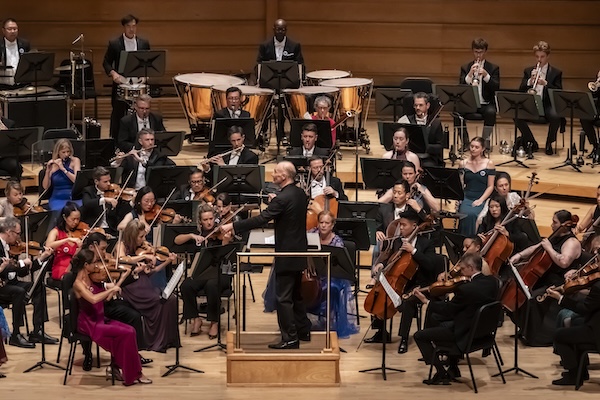
Photo: Scott Suchman
The Kennedy Center commissioned Carlos Simon’s Monuments: A Suite for D.C. for the American semiquincentennial, and the KC Opera House Orchestra recorded it in January. Its four sections reflect four aspects of the capital city: federal, faith, art and culture, and memorial.
Like most music written for official occasions, the suite felt dewy-eyed and anodyne. At a time when limits on federal executive power are being challenged daily—not least in the unnecessary tragedy engulfing the Kennedy Center itself—the inclusion of “Hail to the Chief” in the first movement feels especially ill-considered.
Simon’s background in gospel and jazz made quotations of “Amazing Grace” seem less trite in the second movement (“Faith”), especially as bluesy riffs loosened it melodically. Extended writing for high trumpet in the rather insubstantial “Art & Culture” movement posed difficulty. The final movement (“Memorial”) ground to a halt for a long, cloying harp and flute rendition of “Swing Low, Sweet Chariot.” Allusions to the “Battle Hymn of the Republic” and “Taps” seemed even more mawkish choices, as did ending with hopeful references to “We Shall Overcome.” This pastichy piece proved a rare miss for Simon.
Noseda continued his ongoing championship of 20th-century Italian masters by ending with a suite from Respighi’s La boutique fantasque. For this Ballet Russes collaboration with Léonide Massine and André Derain, Respighi adapted music from Rossini’s Péchés de vieillesse, piano pieces and songs Rossini composed in the last decade of his life. Respighi’s seasoned hand with orchestration lifted the often humble source material into the realm of delight.
The ballet is set in a magical toyshop, with pieces accompanying dances for automated puppets of various nationalities. A Tarantella, based on Rossini’s song “La Danza” (itself adapting a Sicilian folk song that has had a long life, including a memorable appearance in The Godfather), got a little too madcap, unraveling slightly in terms of rhythmic cohesion. A graceful Mazurka and crisply focused Dance Cosaque followed.
In the ballet, a Can-Can movement introduces the male and female can-can dancers, who are tragically purchased by two different families. This music had a raucous energy, as expected of the frenetic nature of the dance. In the Valse Triste, a bell tolled ten times to mark the closure of the store and the plotting of the magical toys to keep the can-can dancers united.
An elegant pizzicato section gave the Nocturne a light edge, followed by a manic Galop as the toys drove away the families who returned to buy the can-can dancers, capping a hope-filled night for the city’s leading orchestra.
Gianandrea Noseda conducts the first subscription concerts of the NSO season, featuring Rimsky-Korsakov’s Scheherazade, Mussorgsky’s Pictures at an Exhibition, and Ravel’s Boléro, 7 p.m. October 1 at George Mason University Center for the Arts and 8 p.m. October 2 at the Music Center at Strathmore. nationalsymphony.org
Leave a Comment