Noseda, NSO spark joy in triumphant appearance at Wolf Trap
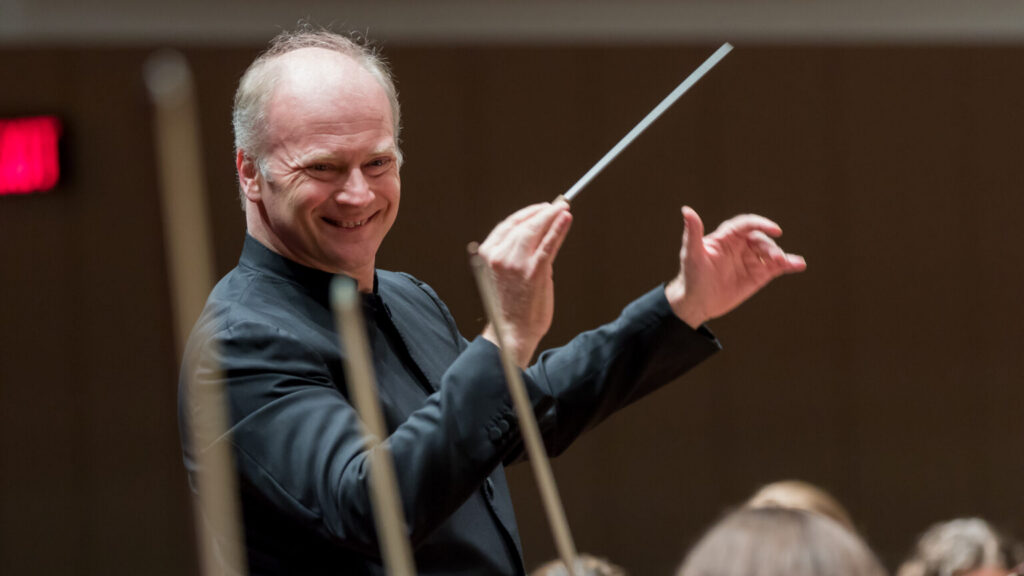
Gianandrea Noseda conducted the National Symphony Orchestra at Wolf Trap Friday night. File photo: Scott Suchman
The National Symphony Orchestra remains in crisis. Ticket sales and donations have plummeted, due to the grotesque politicization of the Kennedy Center by President Trump. Fallout from the disputed closure of the building continues to delay the announcement of next season’s concerts.
Fortunately, amid the turmoil, performances outside its home base seem to be flourishing. A full, enthusiastic audience showed up for Friday night’s concert at Wolf Trap’s Filene Center.
The evening was not the first time that Gianandrea Noseda has led his ensemble in its summer residency, something many music directors would typically hand off to guest conductors. The Italian maestro appeared in his accustomed black from head to toe, in spite of the summer humidity, a contrast to the dressed-down attire of his musicians. With deft political tact, Noseda said nothing about any of the issues currently facing his orchestra and got directly to the music.
Noseda returned to Beethoven’s Ninth Symphony for the main course of this summer program, last performed by the NSO in 2023 at the conclusion of their complete Beethoven cycle. As he did back then, Noseda introduced this most familiar Beethoven work with interesting and unexpected music, in this case two relative obscurities from the composer’s oeuvre.
Beethoven wrote his overture titled The Consecration of the House for the 1822 opening of the Theater in der Josefstadt in Vienna. Significantly, the piece opened the 1824 concert that saw the premiere of the Ninth Symphony, affording the chance to hear the two works reunited. In its sense of heroic joy, heard in abundance in this performance, it served as an appropriate herald of its more famous counterpart.
The NSO responded to Noseda’s emphatic gestures with a well-coordinated reading of the piece, from the crisply unified short chords that opened it to the heroic conclusion. Wolf Trap’s outdoor theater requires an amplification system, but its shortcomings obscured balances among sections of the orchestra. During the trumpet fanfare of the opening march section, the intricate running bassoon accompaniment proved all but inaudible.
Next came an even more rarely heard amuse-gueule, the Elegischer Gesang, originally written in 1814 for string quartet and four vocal soloists. Beethoven dedicated the piece to a friend and patron, whose wife had died at the tender age of 24. Not published until 1826, also around the time of the Ninth Symphony, this five-minute work felt intensely private, an expression of solemn grief leading to the outburst of joy of the main event.
Noseda performed the piece with string orchestra and the voices of the Washington Chorus. Even over the speakers, the burnished strings Noseda has helped polish produced a noble, hushed tone. Likewise the large chorus sang the brief text, a few lines from Friedrich Haug’s poem on the death of philosopher-poet Johann Georg Jacobi, in a delicately petaled blossom of sound. The choir’s excellent diction brought the German words to the ear with great clarity, important in the absence of a supertitled translation.
Noseda took advantage of the piece’s quiet close to begin the Ninth Symphony without a break for applause, a move that emphasized the piece’s revolutionary ideas. Noseda hewed to his uptempo approach to the piece heard in 2023, completing the symphony in just about an hour; the quick tempos of the first two movements proved more convincing this time around. The first movement pulsed with urgency, and its conclusion strongly evoked the steady rhythm of a funeral march.
The Scherzo moved with quicksilver fluidity, the compact theme repeated with pointed crispness from the timpani especially. The woodwinds bubbled happily over elegant strings in the Trio section, with bravura contributions from the horns.
Only the third movement fell short. Begun after a tuning pause to allow the vocal quartet to enter, the Adagio failed to make its full impact because of the precipitous pacing. Noseda rightly allowed a slight slowing to accommodate the decoration of the final variation, opening up space for remarkable horn cadenzas from principal Abel Pereira.
Wolf Trap Opera fielded an impressive quartet of young singers for the finale. Baritone Jonathan Patton lit up the opening of the Ode to Joy section with stentorian force. Soprano Tessa McQueen’s high notes crowned the major vocal climaxes, and tenor Demetrious Sampson, Jr. sang the janissary episode with heroic sincerity. Joining her three colleagues from last week’s Tosca was the passionate mezzo-soprano Cecelia McKinley, whose most recent appearance in last month’s Eugene Onegin proved a highlight of that production.
The Washington Chorus, under the direction of Eugene Rogers, mostly met Beethoven’s outrageous choral demands, as they did with the NSO in 2023. The amassed singers never lapsed in their attention to Noseda’s propulsive tempo and rubato adjustments of it, although the clarity of the text suffered in speedier sections. The male side of the chorus lacked the necessary weight for the mysterious “Seid umschlungen, Millionen!” section, too pale in timbre to sound like priests booming out their unison chant.
In the end, Noseda and the NSO let the music speak for itself, in spite of all that the current political imbroglio has brought them. As usual, the world would do well to heed the lines of Schiller’s poem that Beethoven hammered over and over at the conclusion of this joy-sparking work: “All people will become brothers where joy’s gentle wing abides.”
Ginandrea Noseda conducts the National Symphony Orchestra 8 p.m. Saturday at Wolf Trap. The program with soprano Renée Fleming includes Gershwin’s An American in Paris, Maurice Boyer’s American Mosaic, and Bernstein’s Candide Overture and Symphonic Dances from West Side Story. wolftrap.org