Wolf Trap’s strong cast credibly transports “Tosca” to the Age of Aquarius
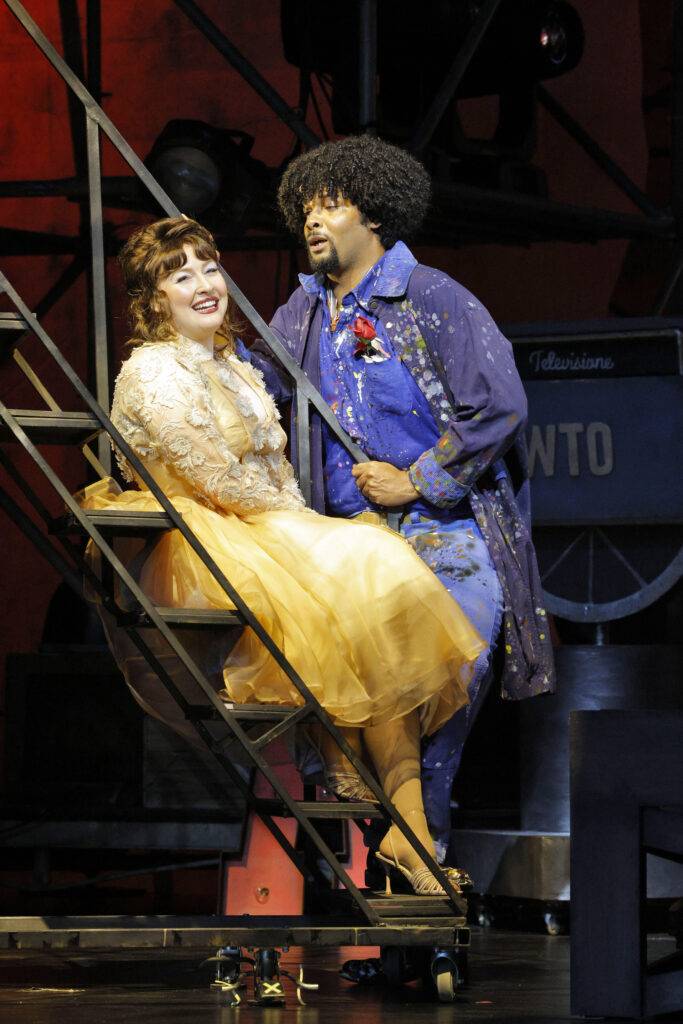
Demetrious Sampson Jr. as Cavaradossi and Tessa McQueen in the title role of Puccini’s Tosca at Wolf Trap Opera. Photo: Cory Weaver
In addition to two boutique productions mounted in The Barns each summer, Wolf Trap Opera puts on a one-night spectacle in the outdoor Filene Center. The opera presented has to be a big enough draw to fill the large theater and its picnic hill, such as Carmen and La Bohème the last two years.
On Friday night the company returned to Puccini’s Tosca for the first time since 2017, in a performance that proved as steamy and stormy as the summer weather.
Wolf Trap Opera, as usual, fielded a worthy cast of young stars for Puccini’s “shabby little shocker,” as scholar Joseph Kerman termed the opera. Tessa McQueen returned to Wolf Trap after her turn as a Studio Artist in 2023, now with impressive Metropolitan Opera credits to her name. Her puissant soprano filled the title role’s dramatic moments with fervor, while her caressing of the nostalgic lines of “Vissi d’arte” showed a sophisticated interpretative ability. Her fitful screaming of some lines, however, sometimes made Tosca more hysterical than dignified.
Tenor Demetrious Sampson Jr., heard last in Silent Night in 2024, complemented McQueen as a Cavaradossi both reserved and heroic. Top notes rang with force in “Recondita armonia” and at his defiant cries of “Vittoria! Vittoria!” with a fist raised in protest. Like McQueen, his poignant legato phrasing most impressed in the character’s showpiece, the melancholy “E lucevan le stelle,” sung while awaiting execution. The lightning and thunder from a summer squall arrived just in time for these dramatic concluding scenes.
Jonathan Patton’s biting baritone, heard last year in Dialogues of the Carmelites, gave a repellent confidence to the villainous Scarpia. Although he lacked the snarling wattage needed to thunder over the chorus in the Te Deum scene, the Act II confrontation with Tosca felt truly depraved. When McQueen surprised him with multiple stab wounds, the audience let loose with appreciative cheers. She then lit his body on fire with film stock from the camera he was recording her, an alteration matched later by her suicide by gunshot instead of dramatic leap.
Fine singing continued down the cast with the stentorian bass of Cumhur Görgün, heard in La Cenerentola this summer, as a resolute Angelotti. Bass Sergio Martinez, the excellent Prince Gremin in Eugene Onegin last month, showed a more humorous side as the Sacristan, costumed in this production like a servile janitor rather than a bumbling priest (costume design by Molly Irelan).
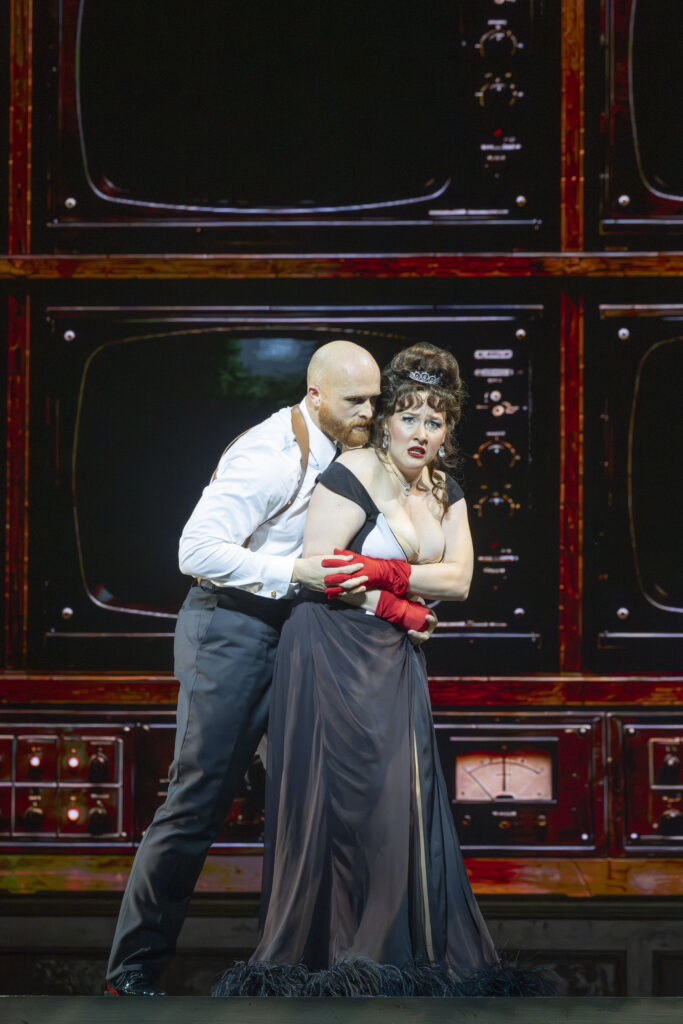
Jonathan Patton as Scarpia with Tessa McQueen in Wolf Trap Opera’s Tosca. Photo: Cory Weaver
A chorus of professional singers, rather than the usual Studio Artists, sounded in top form, notably so in the mostly unaccompanied climax of the Te Deum scene. The Children’s Chorus of Washington, ably prepared by artistic director Margaret Nomura Clark, added a charming touch of innocence as well.
José Luis Gómez, who made his podium debut at Wolf Trap last year, again displayed patient clarity in his handling of the score, including the rather complex off-stage coordinations. In the pit was the Washington National Opera Orchestra, sounding more refined and unified than its usual Wolf Trap counterpart. Harp touches, flute solos, and intimate string combinations all gave a luminous glow to this music, remarkable given the ongoing disruption to these talented musicians’ careers at their one-time home of the Kennedy Center.
Ryan McKinny, who maintains an active stage career as a bass-baritone, returned to Wolf Trap as stage director, partnering with his wife, Tonya McKinny. Like their production of Silent Night two years ago, this concept leaned cinematic, updating the actions to 1970s Rome. The set was backed by a large screen, framed in marquee lights, looking in Act I like a movie theater rather than a church (scenic design by Lawrence E. Moten III). Movie posters for Dario Argento’s 4 mosche di velluto grigio and Fellini’s La dolce vita bookended a central poster bearing the title Tosca.
McKinny, who also designed the projections created by Adam Larsen, used video to evoke Italy in the 1970s as well as add views of the cast. Entrances could be foreshadowed, and the subject of longing in arias depicted. The device became too often heavy-handed, with long-held close-ups of singers and a scene of Tosca cleaning herself of Scarpia’s blood in a shower. Video connection to Cavaradossi as he was being tortured somehow did not really enhance the horror of that scene, as the imagination can make things more gruesome. Studio artist Calista Ro-Jei Smith’s lovely voicing of the Shepherd was synched awkwardly to a video of a boy singing.
Gianandrea Noseda conducts the National Symphony Orchestra and the Washington Chorus in Beethoven’s Ninth Symphony 8 p.m. August 14, with Tosca stars McQueen, Sampson, and Patton joined by mezzo-soprano Cecelia McKinley as the solo quartet. wolftrap.org
2 Responses to “Wolf Trap’s strong cast credibly transports “Tosca” to the Age of Aquarius”
Leave a Comment




Posted Aug 08, 2026 at 5:25 pm by Robert Schwartz
Agree about the wonderful singing & orchestral performances of all!. But in opinion of wife & me, the reviewer’s gentle critique of the staging is too kind. The “update” to 1970s (though done earlier at least in Poland) clashed with the culture of the libretto, which remained rooted in 1900. And the video seemed a substitute for more imaginative use of available resources and staging.
Posted Aug 08, 2026 at 11:02 pm by Nina Schwartz
Your review is too kind. While the music, as always, was riveting, and the singers and orchestra wonderful, the cheap computer scenes and animations constantly dragged viewers’ attention away from them. The lackluster blocking—such as having Cavaradossi sing an aria while sitting down and looking down, shows a lack of thought, looks boring, and in this case, even impedes the singer.
Finally, “reimagining” this opera in 1970s Italy is idiotic. It’s about the first stirrings toward the unification of Italy, with a struggle against tyranny during the Napoleonic wars. The characters are defined by this time. “Reimagining” them and the time shows a lack of research and understanding that makes the whole production look shallow and stupid.