Le Bu makes worthy Vocal Arts debut enhanced by strong pianist
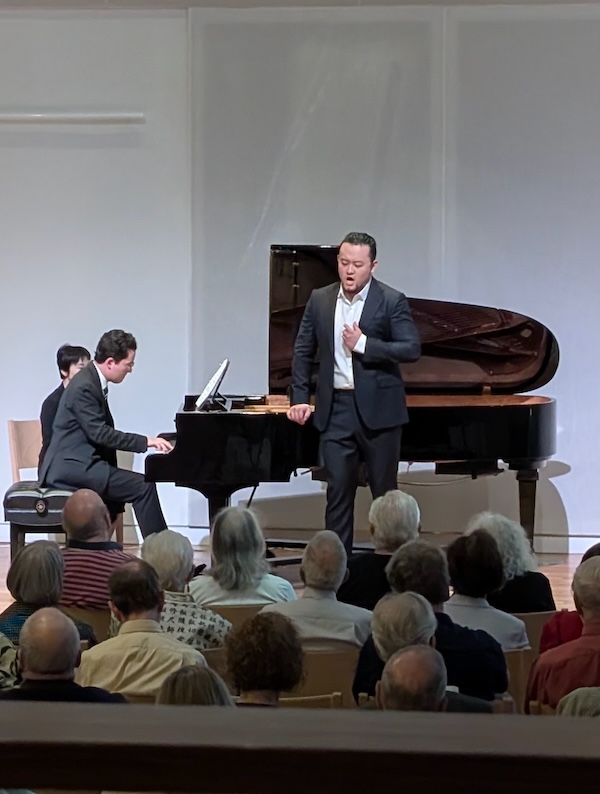
Lei Bu performed a recital with pianist Artyom Pak, presented by Vocal Arts DC Sunday evening. Photo: C. Downey
Washington audiences have applauded Le Bu in recent operatic productions, both at Washington National Opera and Wolf Trap Opera. On stage the Chinese bass-baritone has shown a laid-back personality that belies the intensity of his voice.
Vocal Arts DC presented his area lieder debut, Sunday evening at Live! At 10th & G, the latest installment of its annual emerging artist recital, offered in memory of its founder, Gerald Perman.
Extensive work in the best young artist apprenticeships, including the Metropolitan Opera’s Lindemann program and Santa Fe Opera, have polished Bu’s pronunciation and diction in the languages featured on the program (German, French, English, and Russian). He sang from memory and with a stage actor’s sense of engagement, occasionally evidencing minor textual lapses but always showing impressive confidence.
Bu displayed a solid, vibrant sound across a broad vocal range, encompassing both the bass and baritone sides with warmth and power. The baritone register shone in the opening set of Schubert songs, both a legato richness in “Fahrt zum Hades” and a more biting intensity in “Gruppe aus dem Tartarus.” The forceful side of his voice came out as well in “Prometheus,” rounding out a hell-centered set, further amplified by the vital pianism of his collaborating artist, Artyom Pak.
A more morose side of poetic melancholy came in a set of French songs by Henri Duparc. Bu’s voice lost some of its assurance in softer songs like the more somber “Lamento.” Undertaking “Extase” proved a daring choice, showing off a dulcet high range, phrased with serenity. Still, it was the full-throated climaxes of “La vague et la cloche” that served Bu’s voice best, due in no small part to Pak’s dramatic and virtuosic handling of the preludes and postludes.
In fact, Pak’s sensitive renditions of the sentimental accompaniment in The House of Life by Vaughan Williams made those three selections so effective. English seemed the least comfortable language for Bu in terms of pronunciation, but the fine pacing and dynamic scaling of his pianist helped the ribbon of the melodic line to flow beautifully. Major climaxes, powered by the surging piano, marked the ends of both “Love Sight” and “Heart’s Haven.” The tender conclusion of “Silent Noon” would have benefited from a sweeter tone.
The Vaughan Williams was the only cheerful set in a rather gloomy evening, followed on the second half by Mussorgsky’s Songs and Dances of Death. In the dark-hued “Lullaby,” Bu gave careful vocal characterization to the lines of the narrator, the eerily comforting song of Death, and the panicked reaction of the mother watching her child succumb to illness. He instead used the more virile side of his voice as Death seduced the sick girl in “Serenade,” with a more hostile, menacing finish.
Pak’s skillful, thrilling playing at the keyboard again made Bu’s performance even stronger. The pianist’s rhythmically lilting dance rhythms gave “Trepak” a fearful edge, not least in the searing chromatic scales and powerful postlude. An even more potent tumult of sound from the piano accompanied the imposing figure of Death surveying the casualties spread across a battlefield in “The Field-Marshal.”
In both of these songs, Bu raged with his most ferocious tone, competing with and yet supported by his partner’s musicality. Given how important Pak’s contribution to the recital was, Bu not acknowledging him during the ovations or giving him his own chance to bow seemed doubly odd. The song recital, perhaps more than opera, is after all a cooperative venture.
Having tried his hand at some of the smaller Wagner roles, in Salzburg and Atlanta, Bu turned to Wotan for the single encore. His performance of “Abendlich strahlt der Sonne Auge,” a scene from the end of Das Rheingold, without Fricke’s lines, seemed a worthy audition perhaps for this aspiring Wagnerian. Not to be outdone, Pak brought out the many Leitmotifs burgeoning in the orchestral score to enhance the dramatic effect.
In the 2026-2027 season, Vocal Arts DC will present recitals by tenors Ben Bliss and Matthew Polenzani, soprano Amanda Batista, mezzo-soprano Natalie Lewis, and baritone Huw Montague Rendall. Single tickets go on sale July 15. vocalartsdc.org
