Feola shines brightly in WNO’s ebullient “Marriage of Figaro”
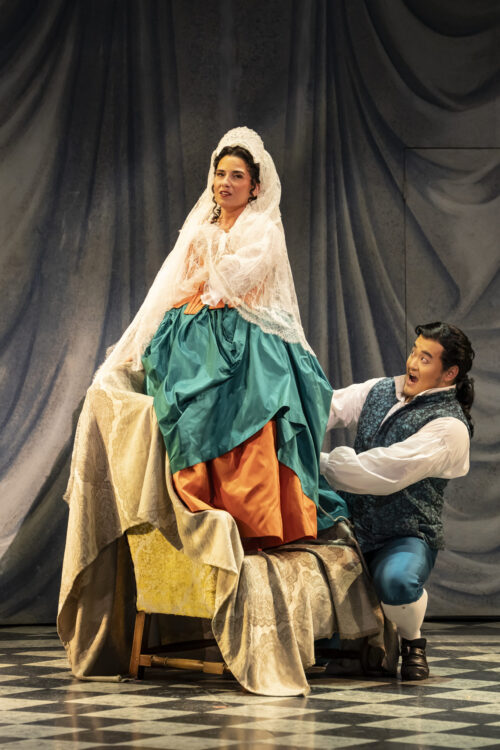
Joélle Harvey as Susanna and Le Bu as Figaro in Mozart’s The Marriage of Figaro at Washington National Opera. Photo: Scott Suchman
Washington National Opera continued its new season in the Kennedy Center Opera House with Mozart’s evergreen Le Nozze di Figaro. The staging, a revival of the 2016 production directed by Peter Kazaras, combined with stellar singing, especially on the treble side of the cast, gave Friday night’s opener everything that delights opera lovers. Robert Spano, in his first podium stand as the company’s music director, presided masterfully.
Sadly this fine production opened under a cloud of uncertainty. In an article published last week, WNO artistic director Francesca Zambello told a journalist that the company was considering leaving the Kennedy Center in the 2026-2027 season. The problem, stated with shocking candor, came down to the 40% decline in ticket sales and related decline in donations to the company, due to former supporters’ opposition to President Trump’s takeover of the arts venue earlier this year.
The Kennedy Center has responded by providing a statement from WNO board chair Andy Pharoah, claiming to the contrary that “WNO has no plans to move out of the Kennedy Center and we are proud to be part of America’s cultural center, entering our 70th season.” While the opening-night audience mostly filled the seats, the house looks undersold for some of the remaining performances on the Kennedy Center’s website.
Kudos to the musicians and singers for persevering in this fraught atmosphere. Outstanding soprano Rosa Feola, who made a radiant company debut two years ago as Juliette, returned as a ravishing Countess. Her limpid voice, poised and beautiful across its wide range, brought both aristocratic dignity and amorous passion to the role, giving tragic depth to both of her major arias. Her stage presence proved no less appealing, for example, in the sparkling Act II trio “Susanna, or via, sortite,” as she pulled a stocking over her long leg while ascending to a shimmering high note.
When Yaritza Véliz had to withdraw, because of visa problems, soprano Joélle Harvey stepped in as Susanna in the second week of rehearsals. Harvey, who made an angelic appearance with the National Symphony Orchestra last year, has sung the role to great acclaim at the Glyndebourne Festival. Her Susanna was vibrantly coquettish, both acted and sung with exceeding charm and comic timing, crowned by an alluring, seductive rendition of the aria “Deh vieni non tardar” in Act IV.
Both lead male counterparts seemed slightly overshadowed by their other halves, both in characterization and vocal volume. Baritone Will Liverman made a strong WNO debut as the Count, incisively sung and filled with jealous rage, with a sympathetic turn in Act IV as the character pleaded for forgiveness from his wronged wife. The Figaro of bass-baritone Le Bu, heard recently as a young artist at Wolf Trap Opera, came off more as a well-intentioned oaf than a clever manipulator of his social betters, with Susanna seeming to pull all the strings.
The decision to cast countertenor John Holiday in the role of Cherubino sounded risky but proved intriguing. Holiday had the full range for the part, written for a woman dressed en travesti, although one inevitably missed some of the mezzo warmth at the top. His acting brought out the adolescent ungainliness of the mischievous page, but the jokes generated by the libretto’s double cross-dressing of the character, a woman playing a man dressed as a woman, are funnier than what this version offered.
The rest of the cast proved equally pleasing, led by veteran mezzo-soprano Elizabeth Bishop returning as the acidic harpy Marcellina, who almost stole the show back in the 2016 production. Rodell Rosel’s mincing Basilio, Willard White’s sententious Bartolo, Hakeem Henderson’s prating Don Curzio, and Kevin Thompson’s blustering Antonio rounded out the opera’s incomparable comic ensemble scenes.
Robert Spano’s tenure as music director promises to be musically invigorating based on his podium manner in this production. His calm and measured conducting gave much-needed solidity to the coordination between platform and pit. The WNO Chorus, cut down to only twelve singers and with only about half of them of long standing, sounded underpowered and occasionally off-track rhythmically. Assistant conductor Michael Baltzer reprised his 2016 role accompanying the recitatives, again on harpsichord rather than the fortepiano now generally preferred for Mozart operas.
Peter Kazaras’s staging proved just as visually grand and diverting as it did the last time around. The neoclassical columns of Benoit Dugardyn’s sets imparted 18th-century grandeur, with clever minor changes to give the impression of the different locations of the four acts, not least the rolling topiary trees for the moonlit comedy of errors at the opera’s conclusion. Myung Hee Cho’s lavish, candy-colored costumes suited the opulence and emptiness of the aristocratic existence lampooned by Lorenzo Da Ponte in the libretto.
The Marriage of Figaro runs through November 22, with a different cast of Cafritz Young Artists slated for this evening only. kennedy-center.org
One Response to “Feola shines brightly in WNO’s ebullient “Marriage of Figaro””
Leave a Comment

Posted Nov 16, 2025 at 12:25 am by Ana Maria Balfour
It was a lovely performance. At a time when laughter is not easily available, le Nozze di Figaro provided plenty of laughs.Excellent performances and a pleasant environment.
It was nice to be back at the Kennedy Center. We were there at its opening many decades ago.