With late subs, Puccini’s gritty “Il Trittico” is a work in progress with Noseda and NSO
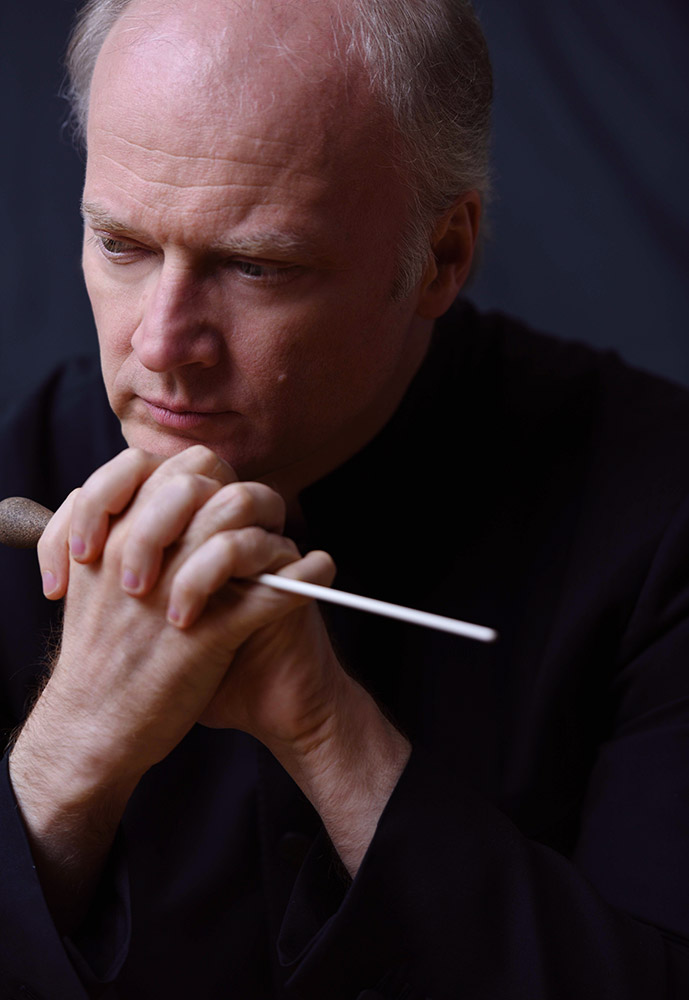
Gianandrea Noseda led singers and the National Symphony Orchestra in Puccini’s Il Trittico Wednesday night at the Kennedy Center. Photo: Stefano Pasqualetti
For the third season in a row, Gianandrea Noseda has devoted one program of the National Symphony Orchestra to a concert opera. Following Verdi’s Otello in 2024 and Barber’s Vanessa last year, now comes Puccini’s Il Trittico, heard Wednesday evening in the Kennedy Center Concert Hall. In addition to some fine lead singers, an ensemble of Cafritz Young Artists from Washington National Opera filled out a mostly strong cast.
Last heard in the area at the Castleton Festival, under the late Lorin Maazel in 2010, Il Trittico is a triple-bill of one-act operas on the theme of deception and damnation. In the brutal melodrama Il tabarro, set on a river boat on the Seine, a husband discovers and kills his wife’s lover. In the spiritual portrait Suor Angelica, a wealthy woman forced to become a nun learns that her illegitimate son has died. Finally, in the farce Gianni Schicchi, a middle-class schemer poses as a dead man to rewrite the man’s will in his own favor.
Noseda returned to Italian soprano Erika Grimaldi, who has sung with the NSO several times, to take all three of the triptych’s lead female roles. Noseda reversed the order of the first two operas from how they were premiered, beginning with Suor Angelica, in which Grimaldi seemed to hold some of her vocal strength in reserve at first, especially in the low range. The distraught nun’s climactic aria, “Senza mamma,” featured some shimmering top notes, sensitively bathed in radiant string sound from the NSO.
Clad in a different gown for each opera, Grimaldi shifted her sound and her stage presence for the more brazen role of Giorgetta in Il tabarro, revealing a more steely edge and overall power. Grimaldi ended up also singing Lauretta in Gianni Schicchi after Sabrina Gárdez withdrew from the cast. Her rendition of the celebrated aria “O mio babbino caro” purred with persuasive tone, not least in the floating high notes. When she strayed rhythmically during the aria, Noseda got her back on track with a prompter-style hissed whisper.
Mezzo-soprano Agnieszka Rehlis showed similar versatility across the three operas, beginning with an imperious Zia Principessa in Suor Angelica. Her bottom notes sounded with heartless force in “Nel silenzio,” when she demanded that her niece give up her inheritance. The brighter side of Rehlis’s extraordinary voice served up light-hearted comic relief as La Frugola in Il tabarro, and she gave satiric bite to the role of Zita, one of the scheming relatives of the not-so-dearly departed in Gianni Schicchi.
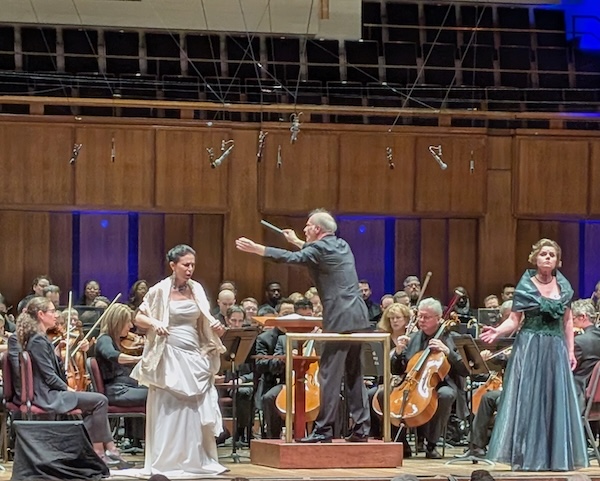
Gianandrea Noseda conducts the NSO in Puccini’s Suor Angelica with Erika Grimaldi (left) and Agnieszka Rehlis. Photo: C. Downey
Russian baritone Roman Burdenko had some rough moments as Michele in Il tabarro, as he was occasionally covered by larger orchestra textures. He also lost track of the beat at one point in that opera, requiring insistent correction from Noseda at the podium. Happily, he brought the necessary humor to the title role in Gianni Schicchi, including impersonation of vocal accent and impeccable comic timing.
Replacing tenor Jonathan Tetelman, who withdrew from the cast last month, Gregory Kunde brought heroic power to his single role, Luigi in Il tabarro. Now in his 70s, the tenor held up convincingly as the voice of the downtrodden worker, even if his gray hair made him look much older than Burdenko’s Michele. The tightly wired vibrato and nasal placement of tenor Hakeem Henderson, a Cafritz Young Artist, gave a nervous edge to his Rinuccio in Gianni Schicchi.
Meryl Dominguez, who replaced soprano Sabrina Gárdez in the cast more recently, made a charming, flighty Sister Genovieffa in Suor Angelica, as well as taking the role of Nella in Gianni Schicchi. As that character, she was part of a delightful trio with Rehlis and the La Ciesca of Michelle Mariposa, who also made a stern Suora Zelatrice in Suor Angelica. Other standouts in the supporting cast included tenor Nicholas Huff and bass Scott Wilde as Tinca and Talpa, respectively, in Il tabarro.
Members of the Washington Chorus, seated at the back of the stage, provided the choral parts with gusto. The choir’s women joined the ensemble of female soloists to constitute a robust convent of nuns making up the entire cast of Suor Angelica. With no choral parts in Gianni Schicchi, the full complement of soloists formed a madcap group of money-hungry relations. Noseda’s bold, sometimes manic gestures helped the NSO sculpt the three different fabrics of this emotional trilogy, from the sublime to the ridiculous.
In another change in the ongoing saga at the Kennedy Center, the performance of the National Anthem at the start of each NSO concert is no longer obligatory. The orchestra omitted the Star-Spangled Banner at this concert and at its last program two weeks ago.
The program will be repeated 7 p.m. Friday at the Kennedy Center, and 2 p.m. Sunday at Carnegie Hall in New York. kennedy-center.org
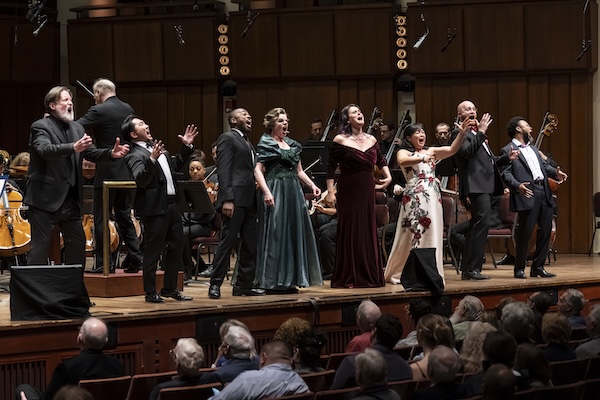
Photo: Scott Suchman
One Response to “With late subs, Puccini’s gritty “Il Trittico” is a work in progress with Noseda and NSO”
Leave a Comment


Posted May 02, 2026 at 11:05 am by Jack Firestone
Attended Friday May 1. Truly an outstanding reading. Noseda continues to share glorious musicmaking with us. Seamless performances by all. Orchestra sounded glorious.
Box office said Orchestra section totally sold-out but looking down from the first tier, there were many vacant seats. Sad because they missed powerful performances.