Fairfax Symphony serves up rare Vaughan Williams, Vivaldi remix in varied program
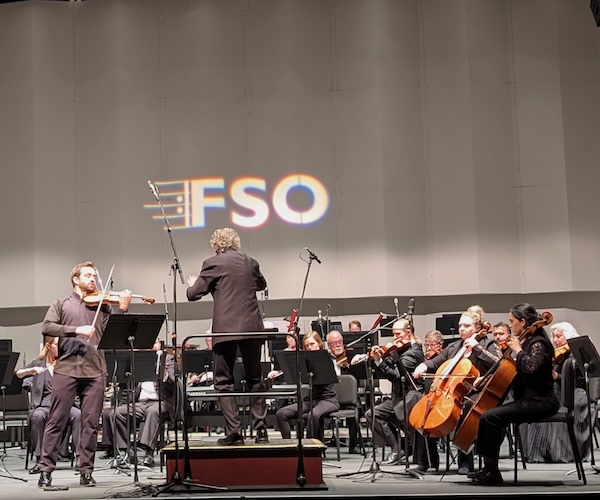
Violinist William Hagen performed with the Fairfax Symphony Orchestra Saturday night at George Mason University. Photo: C. Downey/WCR
Local orchestras should play more of the English symphonists of the 20th century. The Fairfax Symphony Orchestra has done just that, with a program centered on the music of Ralph Vaughan Williams. Music director Christopher Zimmerman, offering brief comments in his charming British accent, led this lovely concert Saturday night at the GMU Center for the Arts.
The evening opened with The Lark Ascending, a piece Vaughan Williams composed first for violin and piano, later reworking the piano part for orchestra. Taking the solo part was William Hagen, the 32-year-old violinist from Salt Lake City who went from child prodigy to competition winner and a career playing around the world. Since 2018, he has played the 1732 Arkwright Lady Rebecca Sylvan Stradivarius violin, loaned from the Rachel Barton Pine Foundation.
In Hagen’s hands, the instrument sang with a limpid tone in the opening cadenza, taken freely and with avian-like twittering motifs. In later sections, Hagen gave virtuosic flourish to the octaves and double-stops, at one point playing deftly to the accompaniment of soft triangle and woodwind solos. The piece shows the melodic influence of British folksong, which Vaughan Williams spent time collecting and recording, a valuable act of musical preservation.
The chance to hear this piece in such an intimate hall proved worth the trip alone. Hagen often played soft passages with whisper-like delicacy, varying each return of the opening cadenza material as if the lark were in different locations and moods. At the conclusion, Hagen floated alone as the orchestra faded away.
No encore followed because Hagen returned to the stage for a nod to contemporary music. In 2012, the film composer Max Richter made a sort of remix of Vivaldi’s most famous work called Recomposed: Vivaldi–The Four Seasons. The original mixed string instruments with synthesizers, which Richter later revised for strings, harp, and harpsichord (music heard in the My Brilliant Friend series on HBO among other places). The FSO played the latter version.
Richter has taken some of these four concertos’ most recognizable motifs, diced them up, and repeated them in overlapping minimalist patterns. In a pleasing connection to Vaughan Williams’ Lark, the birdsong in the “Spring” first movement popped out between Hagen’s violin and those of the violin section in an almost chaotic fashion. Other movements became less recognizable, like “Spring II,” in which the cellos and then the violins got to take a turn as the barking dog described in Vivaldi’s accompanying sonnet.
The “Summer” concerto opened almost identically to Vivaldi’s original, with impressively rapid figuration from Hagen. At moments when the original disappeared, as in the middle of the first movement, the effect proved disappointing. In many of the movements, the amassed repetition ticked away like a clock, coming to a sudden ending like a filmstrip unwinding from its spool, an effect that eventually sounded clichéd.
Keyboard principal Josephine Riggs, playing the synthesized harpsichord part, and harpist Eric Sabatino added unexpected colors to the smaller, more rarified string sound. Richter jettisoned some of the set’s most memorable scenes, like the dripping ice in the fireside scene of “Winter II” and the hunting scene in “Fall III,” with neither baying dogs nor hunters’ horns heard. The moto perpetuo reincarnation of “Winter III” made for a satisfying conclusion to this unusual experiment.
Zimmerman rounded out the evening by leading a fine rendition of Vaughan Williams’ Fifth Symphony, the first of the composer’s nine symphonies heard in the area in almost a decade. The opening of the Preludio simmered with tension, as the bass line held to a C under the sound of D major in horns and strings. The full complement of strings, by comparison to the Richter piece, sounded overall less rhythmically cohesive and overall less in tune. Zimmerman skillfully shaped the climax of the movement, fired by potent brass, before the feeling of the opening measures returned.
In the Scherzo, with its distinctive melody in ascending fourths, the tempo felt a little placid, with oboe solos generally in better shape than flute solos. Mary Riddell played the pastoral English horn solo in the Romanza with beautiful rubato and breath support, a prime part of the orchestra’s best ensemble work of the four movements. The horns had a few off moments, but concertmaster David Salness’ violin solos evoked plaintive serenity, a reminder that Vaughan Williams used much of this music in his opera, The Pilgrim’s Progress.
After the third movement’s seraphic close, the Passacaglia added more rhythmic activity, as it cranked up to the Allegro section. After another finely paced climax, the music of the Preludio returned. With a pedal point on D, the supposed key of this symphony finally crystallized, as the divisi strings soared higher and higher, resolving the unstable chord of the symphony’s opening. Kudos to Zimmerman for this welcome advocacy of the work of Vaughan Williams.
Cellist Yo-Yo Ma joins the Fairfax Symphony Orchestra and conductor Christopher Zimmerman for Shostakovich’s Cello Concert No. 1, paired with Shostakovich’s Sixth Symphony, 8 p.m. December 6. fairfaxsymphony.org
Leave a Comment