Rondeau surveys French harpsichord music for CMM, making it his own
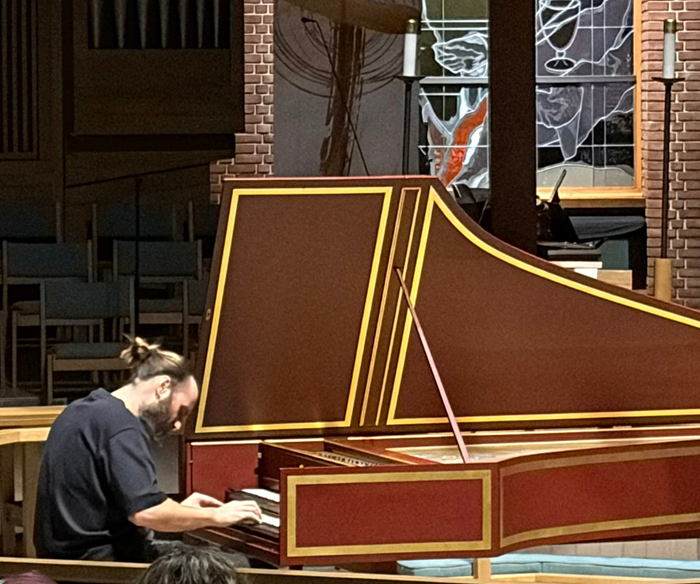
Harpsichordist Jean Rondeau played a recital for Chamber Music Maryland at First Evangelical Lutheran Church Saturday night. Photo: Dane Krich
Jean Rondeau has a way of weaving a program of historical music into something personal and new. The French harpsichordist has made a string of memorable appearances here since his Washington debut in 2015, most recently under review in 2022 with Capriccio Baroque. Chamber Music Maryland presented him Saturday evening, in a blockbuster program spanning the French baroque, at First Evangelical Lutheran Church in Ellicott City.
Rondeau, now 35 years old, has started to describe himself as a keyboard player. In his last concert with CMM, in 2023, he played on a fortepiano and continues to branch out in new directions. His recording of the complete works of Louis Couperin, released by Erato last year, included that composer’s works for organ as well. The disc won this year’s Gramophone award for recording of the year, adding to Rondeau’s list of noteworthy accomplishments.
The program opened appropriately with the “Suite en Ré” of Louis Couperin, the uncle of François Couperin, who died in 1661, before his famous nephew was even born. Rondeau prefaced this work with his own improvised intonatio, a baroque tradition that warms up the instrument and offers a chance to hear how its sound will interact with the room and the people in it.
Improvisation, rather than something divorced from classical music, has generally gone hand in hand with it. Like Bach, Beethoven, Chopin, Debussy, and countless others before him, Rondeau is an excellent improviser. He even plays piano in a jazz ensemble, among his many interests. This improvised introduction connected seamlessly to the unmeasured prelude that opened the suite.
The program thus flowed together through the medium of improvisation, in ways that kept the listener guessing about when they were hearing the composer listed in the program and when they were hearing Rondeau. The rest of Louis Couperin’s suite, five dance movements, came to life through ornate embellishments adorning the repeats of sections, when Rondeau observed the repeats, which was not always. Another form of improvisation, these ornamentations did not sound extraneous to the notated music but like something that grew out of it quite naturally.
Sometimes movements inspired a free, rubato-leavened style from Rondeau, like the Allemande, Courante, and Sarabande of this suite. The Canaries, in the fourth position, instead percolated with metric regularity, but again replete with extravagant ornamentation. Even the repeated rondeau refrain of the concluding “Chaconne la Complaignante” appeared in a different embellished clothing each time.
Transitional improvisation linked the end of the Louis Couperin suite to the Prélude by Jean-Philippe Rameau, which itself introduced selections from his “Suite en La” in the Nouvelles Suites de Pièces de Clavecin. The melancholy Allemande, florid Courante, and poignant Sarabande all received remarkable ornamented repeats. (Two dances, “Fanfarinette” and “La triomphante,” were omitted.)
The first virtuosic display of the evening came in the Scarlatti-like “Les Trois Mains,” taken at a daring tempo so that the athletic hand crossings demanded in the score did indeed sound as if Rondeau somehow had a third hand helping out. The closing Gavotte, by contrast, felt bathed in a hushed sense of interior meditation. Rameau’s six doubles, repeats with ornamentation written out by the composer, offered a look at the model for Rondeau’s own style of embellishment, lavish and inspired.
More improvisation connected the return of Rameau’s Gavotte to the Premier Prélude from François Couperin’s L’Art de toucher le clavecin, an invaluable instruction manual for learning the harpsichord. That rather simple, didactic piece led to two wilder movements from the composer’s vast collection of Pièces de clavecin. The somber “La Ténébreuse,” played with shadowy power, paired beautifully with the more demure “La Favorite,” a thoughtful chaconne, to represent Couperin the Great.
At this point, Rondeau allowed a pause to intervene, although the audience, still perhaps uncertain about where he was in the program, did not applaud. The final piece seemed intended as an encore, although listed in the program: La Marche des Scythes by Pancrace Royer. Heard often, by at least four different harpsichordists in recent years, Rondeau’s take on it eclipsed even Christophe Rousset, although this performance proved more obsessive and driven than violent.
An actual encore followed, with a tender, gentle rendition of Couperin’s celebrated “Les barricades mystérieuses,” transformed by expressive rubato adjustments. With it Rondeau brought out a rather different side of the French double-manuel harpsichord built by Thomas and Barbara Wolf in 1991, a copy of a 1771 Pascal Taskin. As the builder and the performer noted, the instrument is the same age as Jean Rondeau.
Violinist Philippe Quint and pianist Jun Cho play music by Charlie Chaplin, Brahms, Debussy, Stravinsky, and Gershwin to accompany a screening of Chaplin film clips 7:30 p.m. December 12. chambermusicmaryland.org