Fine playing, well-balanced program marks Marlboro concert at Museum of Asian Art
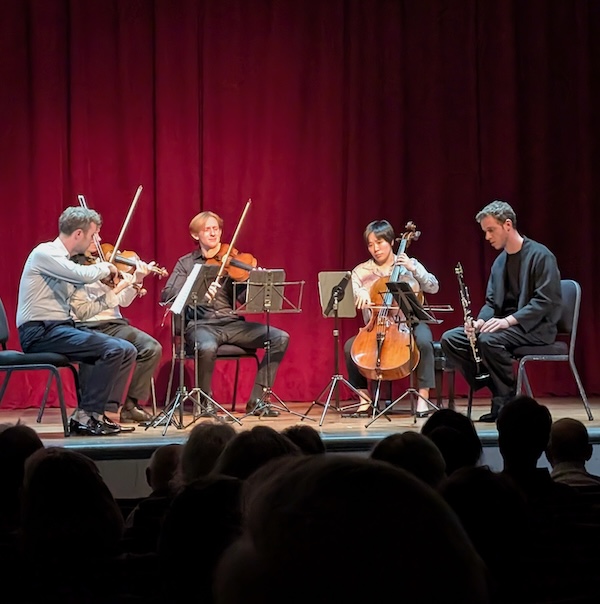
Musicians from Marlboro performed Wednesday night at the National Museum of Asian Art. Photo: C. Downey
The National Gallery of Art has discontinued its regular presentation of free concerts, yet the series at the National Museum of Asian Art continues.
Among programs ranging from pop to contemporary, the museum’s auditorium still hosts the Musicians from Marlboro touring program. The first of these three concerts, featuring selected programs from the Marlboro Music Festival in Vermont, opened the classical offerings of the museum’s season Wednesday night.
Alex Redington, former first violinist of the Doric String Quartet, anchored a string quartet with violinist Leo Appel, violist Samuel Rosenthal, and cellist Elena Ariza. (Redington’s replacement in the Doric, Maia Cabeza, stepped down earlier this month after a tenure of two years.) The luxury of spending some summer weeks together at Marlboro gave the foursome a chance to forge a unified sound in the two quartets heard on the first half.
Haydn’s String Quartet No. 31, the first of the Op. 33 “Russian” quartets, showcased the ensemble’s subtlety. Taking the first violin chair for this work, Appel displayed admirable control of dynamics and vibrato, reaching into the highest range with clarity and impeccable intonation. As a sign of the careful thought behind this interpretation, all four musicians made interesting changes to the repeat of the first movement’s exposition, played with consummate blend.
The second movement’s rapid pacing did not allow time to appreciate the contrapuntal interplay and other unusual elements, but tempos rarely sounded metronomic, with rubato enlivening all four movements. Appel’s frenetic opening to the third movement was balanced by the more thoughtful melodic answer of Ariza’s cello. Appel mastered the fourth movement’s virtuosic runs, even at exhilarating speed, adding a husky touch of Fritz Kreisler tone on the G string.
Brett Dean, the Australian violist and composer, wrote his String Quartet No. 3 (“Hidden Agendas”) for the Doric String Quartet, which premiered it in 2019. Dean has hinted that the subtitle refers to the “strangely fascinating and invariably unsettling political climate of extreme personalities, Twitter-outrage, group-think, and other challenges to the democratic process” that societies were navigating at the time. Redington, who had experience with the piece, switched to the first violin part.
Like most of Dean’s music, the work did not shy away from a full palette of dissonance and special effects. The first movement (“Hubris”) began with the four instruments in rhythmic lockstep, even as they negotiated very sudden stops and starts, played with vehemence. In the second movement (“Response”) shrill, clashing harmonics erupted, eventually receding in a series of softer and softer squeaks before returning in force. This seemed to inspire the shift of the third movement (“Retreat”) towards a flood of little sighs in all instruments, replacing the previous fury with muted restraint.
To reach the softest levels of sound for the fourth movement (“Self-censorship”), Dean has the players use second bows with no rosin on them. Before the movement started, the quartet spent a minute wiping rosin off their strings as well, so that their sound could reach spectrally soft levels. The fifth movement (“On-message”) ramped back up in increasingly angry rhythmic interplay, capping a twenty-minute journey through vast textural variety that never tired the ear. Dean’s piece emphasized expressivity over coherence perhaps, though to nevertheless thrilling effect.
Both Brett Dean and Kaija Saariaho were composers in residence at the Marlboro Festival in the past. The late Finnish composer’s 2011 duet for violin and viola, Aure, featured the two younger musicians, Appel and Rosenthal. With carefully crafted cohesion, the duo fused their sound into one, phasing in and out of unison with one another. The delicate threads of sound they produced often evaporated into fragile harmonics or buzzed as bows moved toward the fingerboard. As a tribute to Henri Dutilleux’s 95th birthday, Saariaho alluded to a melodic snippet from that composer’s Shadows of Time, itself evoking the tragic life of Anne Frank. The piece offered a sober, concise contrast to the longer, more vociferous Dean quartet.
Clarinetist Jonathan Leibovitz joined the quartet for Mozart’s Clarinet Quintet in A Major, one of the undisputed summits of the chamber music repertoire. All of the agitation and sadness of the preceding works melted away in the first movement’s serene opening. Responding to Leibovitz’s meticulous control of dynamics, the string players surged and receded in a free approach to pacing all four movements. Nowhere did this sense of breath suspended come across so clearly as the slow movement, with tender and rarefied tone from both Leibovitz and Redington, again on first violin.
The third movement, a Menuetto with two contrasting trio sections, felt more buoyant and outgoing. The musicians even added modest embellishments on repeats, with an especially charming individuality in the rubato adjustments of the second trio. The rapid-fire brilliance of the Finale, a jolly theme with widely ranging variations, brought the listener back to the style of Haydn, as heard at the start of this excellent and thoughtfully assembled concert.
Pianist Eunbi Kim gives the world premiere of Chang’s The Dreamers, as well as music by Roumain, Negrón, Sasaki, Jani, and herself 7:30 p.m. November 12. asia.si.edu
Leave a Comment