WNO makes the best of a problematic venue with a starry and lean “Nixon in China”
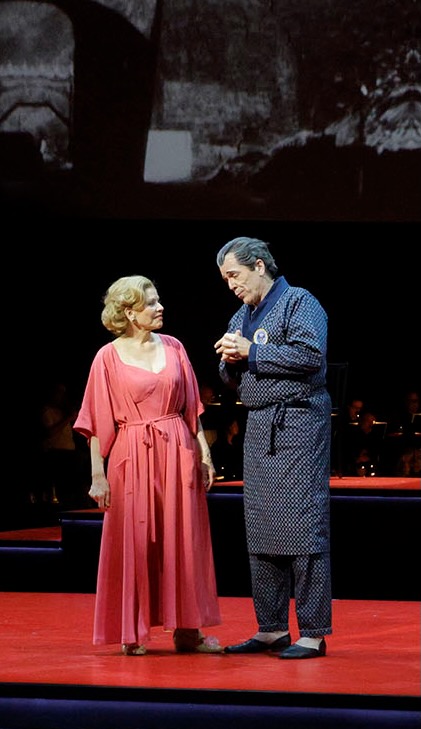
Renée Fleming as Pat Nixon and Thomas Hampson as Richard Nixon in John Adams’ Nixon in China at Washingt0n National Opera. Photo: Cory Weaver
Washington National Opera is mounting its first grand operas since the company’s abrupt divorce from the Kennedy Center in January. This fall’s productions, presented in repertory, include Puccini’s Madama Butterfly and John Adams’ Nixon in China. The latter, last heard in Washington in 1988, shortly after its world premiere at Houston Grand Opera, opened Saturday night for a short run at DAR Constitution Hall.
Adams composed his first opera with librettist Alice Goodman, the start of a fruitful collaboration that she sadly suspended in the midst of their third opera, Doctor Atomic. The story revisited Richard Nixon’s historic visit to China in 1972, only a decade and a half after it occurred. The president held official meetings with chairman Mao Zedong and premier Zhou Enlai, with Henry Kissinger, then serving as Nixon’s national security advisor. The first lady joined him for cultural visits.
WNO has assembled a starry cast, led by Renée Fleming and Thomas Hampson as the Nixons. The soprano and baritone have sung these roles together in the past couple years, on stage in Paris and in concert form with the Boston Symphony Orchestra. Nixon’s often syncopated lines tested Hampson’s rhythmic accuracy at times, but his top notes remain potent and his acting captured the grandiose, sometimes deluded self-importance of a president using an international event to burnish his image before re-election.
Fleming brought poise and dignity to the role of Pat Nixon, as well as a still fairly polished top register. She underplayed the First Lady’s hysterical intervention to help a performer in the communist propaganda ballet the Nixons attended, depicted in Act II. The inane statements Mrs. Nixon makes during her cultural outings, such as taking note of sculpted elephants because they are the symbol of the Republican Party, received the expected laughs.
Kathleen Kim has performed the demanding coloratura soprano role of Madame Mao many times, including in the 2011 debut of the piece at the Metropolitan Opera. Her spitfire top notes gave a thrilling edge to the character’s showpiece, “I am the wife of Mao Tse-Tung,” at the conclusion of Act II. The president’s visit happened toward the end of the bloody Cultural Revolution in China, during which Madame Mao led the purges that even the Chinese Communist Party has called “responsible for the most severe setback” to the Chinese people since the founding of the People’s Republic.
Tenor John Matthew Myers made a vivid Mao, bringing the same heroic power heard from him this past summer at Bard College’s SummerScape festival. His chairman seemed much more spry than how he is often depicted in the opera. The intense Chou En-Lai of Joo Won Kang, warmed over with existential regret, seemed much older by comparison, at least in movement.
Bass Robert Pomakov made less of a standout presence as Kissinger. (The amplification system in use at the hall tends to make lower voices less clear.) The same situation affected the sound of the three secretaries to Mao: mezzo-sopranos Veronica Siebert and Anna Maria Vacca, with contralto Cecelia McKinley. Their obsequious shadowing of Mao–Adams has referred to them as the “Maoettes”—also seemed soft-pedaled in this interpretation.
Director Elkhanah Pulitzer has revived her video-enhanced production for WNO, which was created for a 2017 concert performance with the Los Angeles Philharmonic. Projection designer Bill Morrison has matched most scenes with corresponding archival footage from the real Nixon visit, shown on large screens facing every direction. A projecting stage thus required little by way of sets or props, extending the minimal action into an area filled with cocktail tables for well-heeled guests.
The placement of the WNO Chorus, down to just twenty-five singers and reading from scores, along the rear wall behind the orchestra made them tangential to the action. With their voices piped through the sound system, they became a somewhat confusing, disembodied presence, underlining the fact that this is a concert performance in all but name.
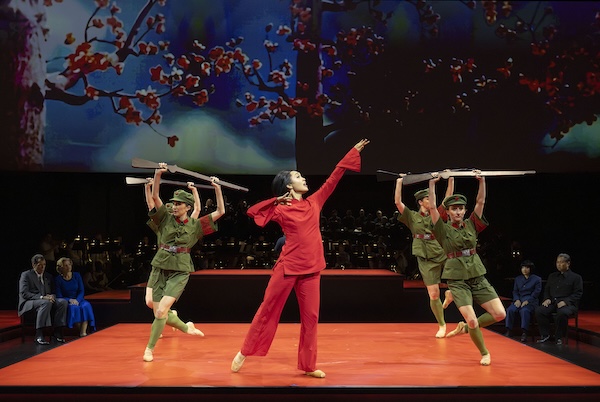
Kayla Mei-Wan Thomas (center, in red) and WNO Corps Dancers in “Nixon in China.” Photo: Cory Weaver
Eight dancers from the WNO ballet corps did their best to bring some pageantry to the political ballet The Red Detachment of Women recreated in Act II. Yet the choreography by Jessica Lang too often seemed awkward and repetitive. In Act III, the connection between the lead woman dancer, costumed in red, and a CCP soldier was connected with Mao and his wife’s early relationship.
WNO music director Robert Spano presided expertly over this complex score, his firm beat leading the large ensemble through Adams’ bewildering metric challenges. The WNO Orchestra, bolstered by saxophones and synthesizers, sounded potent and in lockstep. Little instrumental vignettes throughout steeped the hall in a stew of sounds, like the funky sax bop of the scene “Founders come first” in Act I. Set against the chorus and orchestra at full volume, no soloist could possibly compete, even with amplification.
The DAR Constitution Hall venue was one of the expected downsides of WNO’s departure from its former home, precipitated by artistic director Francesca Zambello’s public comments a year ago. The company had suffered through the cavernous auditorium’s acoustics, wholly unsuitable to opera, for a brief period in 2002-2003 when the KC Opera House was undergoing renovations. Fortunately, WNO has had better luck with last spring’s two productions at Lisner Auditorium, which does not have an orchestra pit either.
Whether one agrees with WNO’s decision to leave the KC or not, President Trump’s closure of the Kennedy Center for a two-year renovation has nevertheless required all the venue’s resident groups to find new digs if they wanted to have a season. Making the split public and bitter has resulted in one significant drawback: a troubling legal morass involving WNO’s endowment, which now must be disentangled from the KC’s finances. As of last month, when the KC submitted its response to WNO’s lawsuit, the situation remains unresolved in court, adding to the financial pressure facing WNO.
While the costly changes to the hall reduced the number of seats to a number closer to that in the KC Opera House, the experience still felt akin to hearing an opera performed in a football stadium. For Nixon in China, always intended for and performed with amplification, the sound system was more tolerable.
Nixon in China runs through November 21 at DAR Constitution Hall. washnatopera.org
Leave a Comment