Abrams deftly leads NSO in Snider premiere, works by section
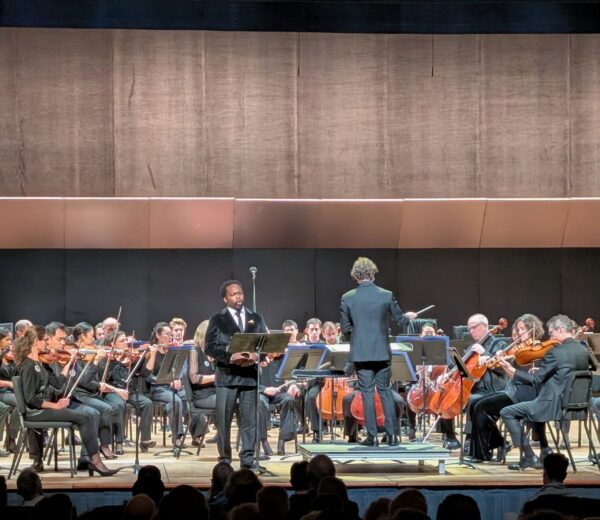
Baritone Will Liverman was the soloist in the world premiere of Sarah Kirkland Snider’s “Urge,” with Teddy Abrams conducting the National Symphony Orchestra Thursday night at Lisner Auditorium. Photo: C. Downey
The National Symphony Orchestra’s program this week deconstructs the orchestra, laying three sections of instruments out on a platter like a high-end dessert.
Teddy Abrams, music director of the Louisville Orchestra since 2014, brought an incisive beat and clear-headed interpretation to all four pieces, heard Thursday night at Lisner Auditorium.
Abrams made his NSO debut, back in 2019, conducting a striking world premiere, Lera Auerbach’s ARCTICA. The entire orchestra came together in this program only for the world premiere of Sarah Kirkland Snider’s Urge, an extended song for baritone and orchestra co-commissioned by the National Symphony Orchestra. The piece sets a new poem by Tracy K. Smith, a hopeful celebration of the American bicentenary with echoes of Walt Whitman’s open-hearted embrace of life.
Bass-baritone Will Liverman, for whom Snider created the work, sang the poem with impassioned urgency, as if its vision of connection to nature and history were bubbling forth in the moment. “Perhaps I am invisible, anomalous, but I believe I exist,” rang out the piece’s emotional climax, “I shake history free.”
Snider set the poem in a neo-romantic style that varied little over the course of fifteen minutes. A gentle tempo and rocking rhythms couched the poem in an overly sentimental vein for the most part. Some bracing dissonance intruded in orchestral interludes, when the NSO musicians could play with more power. As Snider said in her brief introduction, her vision of the poem is not a political statement. Yet by avoiding anything pointed, she has produced a piece that felt misty-eyed rather than urgent.
The evening opened with the woodwinds and brass in Igor Stravinsky’s Symphonies of Wind Instruments, last performed by the NSO in 2018. The twelve woodwind players navigated the complex textures with a broad range of instrumental color, from the high clarinet theme that returns in different guises to the percolating clamor reminiscent at times of The Rite of Spring.
The eleven brass players added an aura of cool spikiness, in broadly spaced bitonal chords that bristled in the air. Some of the louder, sharper attacks reverberated uncomfortably off the walls of the smaller auditorium, a reminder that the musicians are still getting used to playing in six different venues this season. Abrams conducted the piece, which sports an extraordinary number of metric changes, with admirable clarity and confidence.
Michael Tilson Thomas’s Street Song put the brass section in the spotlight alone. Composed for brass quintet and later expanded for twelve musicians, the piece opened with crisply focused ensemble unity. The middle section featured an elegiac theme, leaping broadly like a yodel, that began in the horn. As the piece picked up speed in its concluding section, enlivened with the rhythms and harmonic color of jazz, Abrams’ clear gestures kept the complex music aligned across the ensemble. (Abrams, who began studying with MTT at age 12, offered a touching tribute to the American conductor, who passed away last April.)
The only section left to hear from was the strings, who took the stage in great number for an energetic performance of Tchaikovsky’s Serenade for Strings. (Tchaikovsky called for this size of ensemble in the score, writing, “The larger number of players in the string orchestra, the more this shall be in accordance with the author’s wishes.”) Abrams elicited a full dynamic range from the NSO strings, with a somewhat frenetic edge in the fast movements.
The first movement, after the slow introduction, moved so quickly that the disjointed accompaniment figure for the cellos fluttered indistinctly. Abrams might have done better to luxuriate a bit more, particularly in the Valse of the second movement. Where he did take more time, in the mournful third movement, the tender aria-like melody unfolded mysteriously in the violins, answered by the violas and cellos. The ending chords, in shimmering high harmonic notes, glowed.
The Tema russo of the Finale abounded in spirit, with a robust tempo that drew forth an athletic display from all musicians. In spite of the limitations from Abrams’ overly insistent direction, the piece offered the chance to appreciate the sound of the NSO strings, which Gianandrea Noseda has developed more than any section with his hires as music director. With every year that passes, their sound becomes more refined and elegant, and the new venues seem to be encouraging the musicians to listen to one another in new ways.
The program will be repeated 8 p.m. Saturday at Lisner Auditorium. kennedy-center.org
Leave a Comment