Emmanuel Choir rises to the challenge of 20th-century masterworks
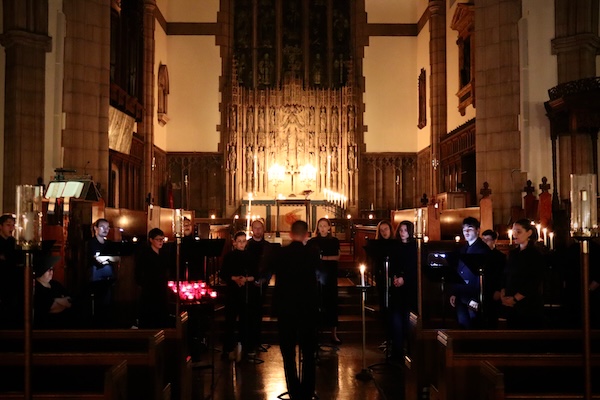
The Emmanuel Choir performed masses by Pizzetti and Frank Martin Sunday in Baltimore.
In the Catholic tradition, the month of November is devoted to remembering the dead. In the earlier darkness after the fall time change, the Emmanuel Choir sang a solemn program of 20th-century sacred music Sunday evening, all without instrumental accompaniment. Candles on the altar and down the aisles, symbols of hope and memory, lit the sanctuary of Emmanuel Episcopal Church.
Christian Lane, director of music at the church, scheduled just over an hour of challenging music from his sixteen professional singers, with no intermission. The first of two modern masterpieces, both informed by medieval and Renaissance music, was Ildebrando Pizzetti’s Messa di Requiem.
Commissioned in 1922 to mark the birthday of the murdered king Umberto I, the work sets part of the Latin texts for the Mass of the Dead. Pizzetti wrote the opening movements for five-voice choir, with the second bass part initiating the Requiem movement in a solemn, chant-like unison.
The singers made a beautiful ensemble sound, ranging from ethereal to robust, with some more exposed divisions revealing slight stridency in the upper male and female voices. In the Kyrie eleison, a more contrapuntal texture featured the unified balance among the choir’s four sections.
Pizzetti’s setting of the Dies Irae is quite dramatic. The composer shows reverence for historical music in his use of the Latin sequence’s Gregorian melody, first stated plainly and then more loosely paraphrased. Lane paced those sections precipitously, giving a wailing quality to the keening melismas (“Oh!”) that answered the chant like distressed souls, often emphasizing the diabolical interval of the tritone. Biting contrasts of loud and soft further enlivened this longest of the movements.
The texture in the sequence expanded to six and then eight parts, but Pizzetti wrote the Sanctus for a triple choir format, one women’s choir (SSAA) and two men’s choirs (each TTBB). With the male singers now one on a part, the women’s voices dominated the textures too powerfully. The compact Agnus Dei went the other direction, with just four parts meant to be sung by only half the choir. Lane’s singers made their most rarefied sound in this movement, and the stark open-fifth endings (“saeculum per ignem”) in the Libera Me locked into place with impeccable intonation.
As a palate cleanser, the musicians offered an impassioned, grief-filled rendition of “Take Him, Earth, for Cherishing” by Herbert Howells. The chant-like opening, followed by simple textures almost like medieval organum, joined nicely to the end of the Pizzetti piece. Howells composed this piece for a memorial service for another slain leader, President John F. Kennedy, which took place at the National Gallery of Art in Washington in 1964. The choir again tuned the rich harmonies of this moving piece with admirable precision, with the second basses rumbling down to the low B off the staff in the final chord.
Frank Martin’s Mass for Double Choir tested the mettle of Lane’s singers, leading to some fatigue evident in the extended ranges, especially the top notes for the sopranos. The Swiss composer was the son of a Calvinist minister, but he was living in Rome when he began writing this piece in 1922. Although Martin did not incorporate Gregorian chant in the piece, as Pizzetti did, the music of Palestrina and Bach had an influence.
The choir sounded more polished in softer moments, like the deep-set D minor chord droned under the middle of the Gloria. Due to both their stamina in such a program and their unflagging breath support, the musicians performed remarkably well. The interplay of the higher voices at the moment of resurrection in the Credo sparkled effusively.
The interpretation of the Martin piece reached its apogee in the Sanctus, where the modally inflected soprano line rocked gently against the meditative underpinning of lower voices. Rhythmic dynamism pervaded the Pleni sunt caeli and other later sections of the Sanctus. A similar contrast of ostinato patterns and syncopated tune marked the meditative opening of the Agnus Dei, rounding out an impressive evening of polished choral reflection.
Amit Peled leads the Mount Vernon Virtuosi in Rota’s Concerto per Archi and Tchaikovsky’s Souvenir de Florence 7 p.m. November 7. emmanueldowntown.org
Leave a Comment