Music of Brahms and Bonds offer complementary solace with The Thirteen
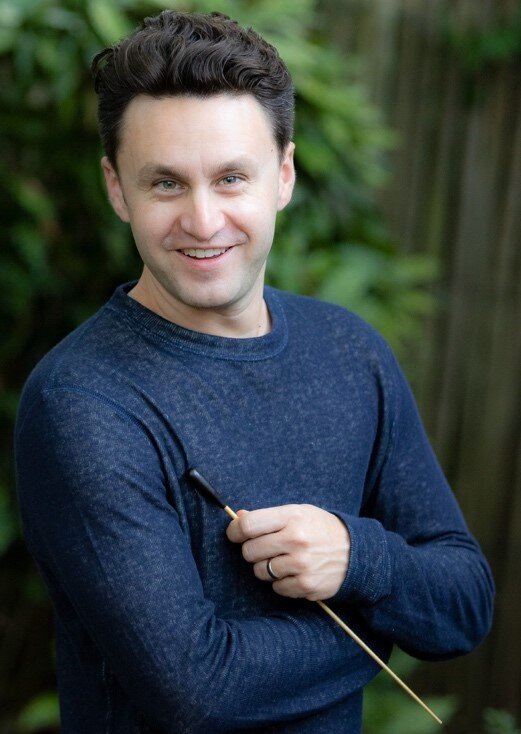
Matthew Robertson conducted The Thirteen in music of Brahms and Margaret Bonds Saturday night at National Presbyterian Church.
When one sits down inside a church for a performance of pieces entitled Credo and Requiem, one expects an afternoon dense with theology. But on Saturday afternoon in the glow of National Presbyterian Church’s stained glass, audiences were instead led through a hopeful humanistic meditation on freedom in life and death by The Thirteen.
The chamber choir’s program paired African-American composer Margaret Bonds’ Credo with Johannes Brahms’ enduring choral favorite A German Requiem. The two pieces echo each other in structure with both featuring non-traditional texts: in Bonds’ case, a 1904 poem by W.E.B. DuBois, and in that of Brahms’, Biblical selections from Luther’s German translation. Both pieces are arranged in seven sections, and feature a male and female soloist alongside the choir. But Credo clocks in at roughly one-third the duration of the Requiem, and struggles to stand out against the enormity of the latter.
Nevertheless, Bonds’ Credo is a piece that justly deserves to be heard, and it was performed well Saturday by The Thirteen. DuBois’ text creates a declaration of faith in the dignity of all people, especially those oppressed for their race, and draws on traditional Christian verses to affirm this dignity.
Bonds complements the text with varying musical colors. “I believe in the Devil and His Angels” was appropriately bold and dissonant, with rough, percussive accompaniment provided by pianist Brian Ganz, and contrasted well with the sweet and tranquil mood of the following section “I believe in the Prince of Peace,” colored with folksong-like harmony.
Soprano soloist Zoe-Elizabeth McCray gave a divine performance of “Especially Do I Believe in the Negro Race,” with a sweet, clear tone. She added appropriate expressive weight to the flattened thirds and accented a melody that brings out the work’s roots in African American spirituals and blues.
Bass Evan Tiapula delivered a wide range of dynamics and phrasing in “I Believe in Liberty,” and did a fine job navigating one of the longest solo sections in the work. Under director Matthew Robertson’s baton, the choir was attentive and sensitive, shifting easily from full, powerful, and accented singing to quiet, smooth, and velvety. Occasionally opening consonants were cloudy, but their precision and unity in navigating tempo shifts was praiseworthy, especially in the rallentando which opens the final section “I Believe in Patience.”
The choir turned to Brahms’ Requiem after intermission, and the ensemble’s greater familiarity with this music was immediately apparent, with Robertson conducting without a score. It is clearly a work held dear to his heart, for he was active in shaping every phrase, placing each word of the text, and managing the dynamic ebbs and flows of Brahms. The choir sang from their scores but was similarly unrestrained, and an even more confident sound was given throughout compared to the first half.
The acoustic of the church’s towering sanctuary at times impacted the clarity of the choir, and male voices were sometimes less clear when the piano accompaniment became thunderous.
Still, excellent control of dynamics and broadness of tone were the ensemble’s strengths throughout this performance. In quiet sections, such as the sparsely accompanied opening chords, the choir sounded rich and full even at a hushed volume; the crescendos from the most timid of pianissimi to the broadest of fortissimi were like the rolling and crashing of a huge wave on the shore. Precision and synchrony were also a strength, especially when Brahms’ counterpoint turns treacherous as in the grand fugue of “Denn wir haben hie keine bleibende Statt.”
Bass-baritone Edmund Milly provided the male solos. His voice was strong and unstrained, projecting easily from the top to bottom of his range, even at moderate volume. Soprano Andréa Walker sang “Ihr habt nun Traurigkeit,” with a focused tone that carried well, though she was somewhat flat in musical phrasing and expression.
The four-hand piano accompaniment was provided by Ganz and Eric Conway. The pair played as a single unit, in perfect time and expression with one another under Robertson’s careful, emotive direction. The thundering crescendi they provided underneath the choir was a treat. Hearing the work performed without orchestra allows the choir to fully take focus, and for the audience to hear the work as a choral piece first and foremost.
The program will be repeated 5 p.m. Sunday at Bradley Hills Presbyterian Church in Bethesda, MD. thethirteenchoir.org
Leave a Comment