Adams, Josefowicz return to NSO with an empowered storyteller in “Scheherazade.2”
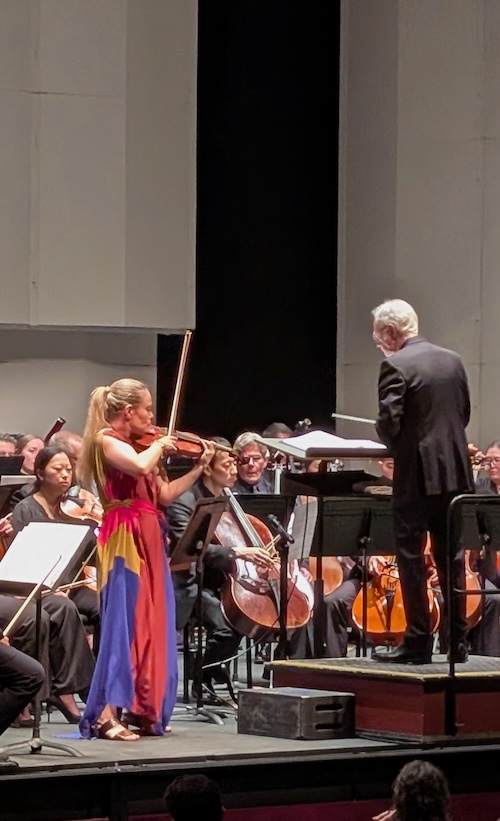
Leila Josefowicz performed John Adams’ Scheherazade.2 with the composer conducting the National Symphony Orchestra Friday night. Photo: C. Downey
The composer John Adams comes to the area periodically to conduct an orchestral program, usually featuring one of his own pieces. He returned to the podium of the National Symphony Orchestra this week for his first guest stint with the ensemble since 2013. Adams brought along violinist Leila Josefowicz, who last played with the NSO in 2018, for a concert at the George Mason University Center for the Arts Friday night.
Most importantly, Adams led the first NSO performance of his own Scheherazade.2 with the NSO, over a decade after its 2015 world premiere by the New York Philharmonic. Adams described this substantial work, part violin concerto and part dramatic program symphony, as a sort of sequel to Rimsky-Korsakov’s famous tone poem (heard from the NSO under Gianandrea Noseda two weeks ago), another example of Noseda’s knack for ingenious programming.
In the Arabic story collection One Thousand and One Nights, Scheherazade manages to delay succumbing to the fate of the many wives who came before her, executed by her royal husband, because of her prowess at story telling. Eventually she is condemned to death, but depending on the version of the story, she usually pleads successfully for forgiveness. Adams instead depicts her resisting her condemnation, fleeing, and finding sanctuary elsewhere.
“I imagined a modern, empowered woman,” Adams said in a brief introduction to the performance, adding context to the nature of the conflict Scheherazade faces in the piece. For the “True Believers” who confront her, Adams said he had “videos of the Taliban or the treatment of women here in the United States on my mind.”
Adams wrote the solo violin part for Josefowicz, and her mastery of the work, played from memory, proved an essential element in the piece’s impact. With impeccable intonation and acrobatic virtuosity, she incarnated the indomitable spirit of the title character.
Adams carefully guided the NSO, never allowing their sound to overwhelm Josefowicz or the other principal voice in the orchestral texture, the cimbalom. Adams has used this Hungarian folk instrument, a sort of zither played with hammers, in a few of his works, including his 2022 opera Antony and Cleopatra. Chester Englander, a virtuoso of the instrument, mixed its distinctive metallic rattle skillfully into an already busy orchestral fabric.
Josefowicz plays these days on a modern violin, made for her by Samuel Zygmuntowicz. The tone could be incisive, even intentionally strident, but with a luscious luminosity at the top of its range and a throaty huskiness in the low. The most rhapsodic sounds came in the mysterious second movement, called “A Long Desire (Love Scene),” alternating with agitation at times, punctuated by piercing brass and clapped wooden snaps from the battery’s whip.
The NSO musicians and Josefowicz moved in close coordination, with the loudest orchestral sound in the third movement, as the orchestra gave voice to the “Men with Beards” condemning Scheherazade in angry outbursts. After fiercely battling her way through the escape depicted in the Finale, Josefowicz wove her most serene sound into the plush string harmonies that concluded the piece, evoking a sense of safety and deliverance. This conclusion rounded out the compelling musical arc of this sprawling piece, whose subtleties came across much more effectively in this live performance.
Adams proved not quite as adept at conducting other composers’ music. The concert opened with his own arrangement of Three Tangos by Astor Piazzolla. The most attractive of these, the slow, sultry “Oblivion,” showed the Argentinian composer in the best light, with a sugary melody made savory by lush harmony. Both “La Mufa” and the famous “Libertango,” from earlier in Piazzola’s career, featured some odd choices of instrumentation and a slight lack of ensemble unity resulting in part from the conductor’s overly effusive gestures.
Similar results were evident in the Suite from Lieutenant Kijé, Prokofiev’s score for the anti-Tsarist satirical film directed by Aleksandr Faintsimmer. The titular officer, a fiction given birth by a clerk’s notation error, has to be maintained as real so as not to incur the wrath of a vain, narcissistic emperor who hates to admit error. Distinctive solos from cornet, double-bass, celesta, and tenor saxophone all registered effectively, but the overall effect lacked some cynical edge and precision. The most impressive movement was the fifth, where the work’s many themes were woven together in an often polytonal texture, implying the layers of deception and confusion in the story.
Leonard Slatkin returns to the NSO to conduct Joan Tower’s Love Returns, his own Schubertiade, and Rachmaninoff’s Third Symphony 7 p.m. October 22 and 11:30 a.m. October 23 at Schlesinger Hall and 8 p.m. October 24 in the Music Center at Strathmore. nationalsymphony.org
Leave a Comment