Perlman still packs them in with his easy-going artistry at Strathmore
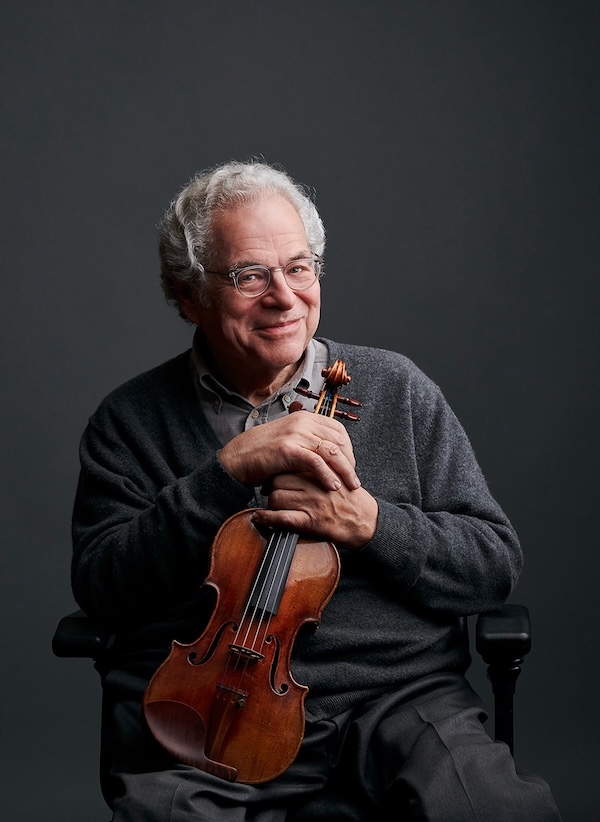
Itzhak Perlman performed with pianist Rohan da Silva Wednesday night, presented by Washington Performing Arts.
At the age of 81, Itzhak Perlman has nothing to prove; his concerts and recordings have cemented his stature as one of the great violinists of our time. Fans of all ages filled the Music Center at Strathmore for his performance Wednesday night, which was presented by Washington Performing Arts.
Perlman and pianist Rohan da Silva, his longtime collaborator, presented a program of three agreeable works, not too demanding technically but requiring keen musical understanding. The performances proved uneven, but the best parts reminded one of the wisdom that comes with time.
In an after-concert discussion with Washington Performing Arts president Jenny Bilfield, Perlman repeated the old question asked of every young hotshot fiddler: “But can you play Mozart?” Indeed, the program opened with Wolfgang Amadeus Mozart’s Violin Sonata No. 32 in B-flat. Perlman and da Silva showed a deep understanding of Mozart’s style, playful and graceful, sound balanced perfectly between violin and piano, with an Andante that provided sentiment without turning mawkish.
Unfortunately, Perlman also had a host of technical problems in the Mozart, from uncertain attacks to intonation miscues to wobbly spiccato. His tone sounded small and pallid at times — not a great performance from anyone, and a little shocking coming from a longtime technician like Perlman.
Richard Strauss’s Violin Sonata, demanded less intricate maneuvering from Perlman and more full-bodied Romanticism. The violinist proved more than capable of providing it, using a round, shimmering tone and hitting the occasional sharper attacks with more precision. He adeptly shaped Strauss’s heroic melodies in the first movement and was appropriately spontaneous in the second, marked “Improvisation — Andante cantabile.”
Da Silva proved an equal partner here, with colorful playing that matched and spurred on Perlman. The pianist’s solo in the opening Andante pages of the finale began with mysterious, grave harmonies that resolved into a triumphant Allegro, with Perlman and da Silva sharing in the joy that followed.
Antonin Dvořák wrote his Sonatina in G major, which closed Wednesday’s program, during his time in New York City. The composer scaled the Sonatina to the technical capabilities of his 15-year-old daughter and 10-year-old son, although, he said, “even grown-ups, adults, should be able to converse with it.”
Perlman and da Silva used their experience to bring out the best of Dvořák’s piece. In this simpler work, Perlman showed a sharp attack, with alluring and varied tone color. Equally important, he had full command of Dvořák’s interpretation of African-American and Native American melodies and rhythms, particularly in the rhythmic snap at the end of the first movement’s principal theme, which so often gets smoothed out in performance. The Larghetto’s theme, a spiritual-inflected song, came off Perlman’s bow fresh and unaffected yet moving, while the Scherzo had an irrepressible spring in its rhythm, Perlman and da Silva putting a winning twist at the end of the graceful melody. The duo went into a full gallop for the finale, pressing ahead with its toe-tapping theme, light and infectious.
When Perlman and da Silva emerged for their inevitable encores, they came out with a huge stack of music, while Perlman consulted a sheet of paper he said was “a computer printout of everything I played in this neighborhood since 1912” to help him choose a relative novelty. Eventually, he settled on two, performed between further jokes.
A transcription of Johannes Brahms’ first Hungarian Dance was rollicking and witty. Perlman performed John Williams’ theme from Schindler’s List, showing he still knows how to use subtle light and shade to make a moving melody even more so.
Even with his technique fading, in less challenging repertoire that still had some bumps, Perlman retains a sharp musical mind. More to the point, he is still having fun making music, and giving a crowd something to appreciate.
Washington Performing Arts presents pianist Simone Dinnerstein Sunday, October 18. washingtonperformingarts.org
Leave a Comment