Opera Philadelphia’s superb cast elevates a convoluted plot in Mozart’s “Mitridate”
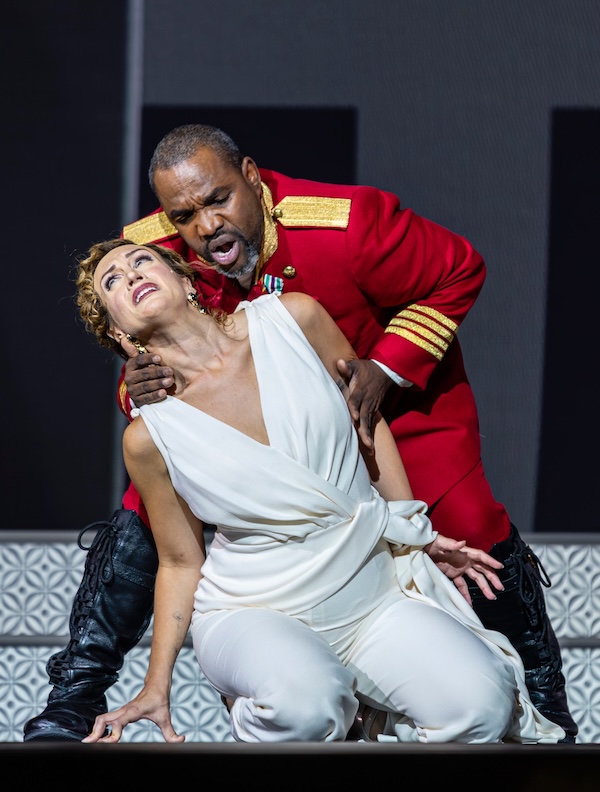
Lawrence Brownlee in the title role and Brenda Rae as Aspasia in Mozart’s “Mitridate” at Opera Philadelphia. Photo: Dominic Mercier
Opera Philadelphia opened its 2026-27 season Wednesday evening with the local premiere of Mozart’s youthful Mitridate, re di Ponto, presented at the Academy of Music.
The titular king of Pontus, Mitridate, is presumed dead after a battle with Rome, leaving his two sons Farnace and Sifare to battle for his throne and, more importantly, the hand of his fiancée, the queen Aspasia. When Mitridate unexpectedly returns alive with the Parthian princess Ismene in tow as an intended bride for Farnace, suspicions of political and romantic disloyalty erupt into all-out war, ultimately leaving Mitridate dead by his own hand with his sons and brides left to face the wrath of Rome together.
The work’s twisting plot of loyalty and betrayal is elevated by a cast of dedicated singers with the vocal talent and acting ability necessary to maintain momentum and even humor. Those elements proved essential in a Mozart opera weighted down with long (though lovely) solo arias and not much else.
Lawrence Brownlee stars as the titular Mitridate. The celebrated tenor portrays the king as weary and old, lashing out at anyone who challenges his denial of reality. Brownlee manages to navigate between the extremes of exhaustion and explosive anger believably, and he is compelling even when throwing chairs across the stage or condemning his family members to execution. His voice is as strong as ever, with sparkling tone, a piercing high register, and nimble coloratura in his multiple rage arias.
Anthony Roth Costanzo takes the stage as Mitridate’s elder son Farnace (supplementing his role as Opera Philadelphia’s general director and president). Costanzo feels completely at home on this stage, slinking around the room, kicking over furniture, and throwing anything he can get his hands on in a perpetual temper tantrum. His countertenor is lithe and athletic, making a game of Mozart’s demanding runs and jumps. His over-the-top stage antics are a delight to watch, but no less impressive is his change of heart in Act 3’s “Già dagli occhi il velo è tolto,” when he manages to fill the room with his quietest, gentlest tone.
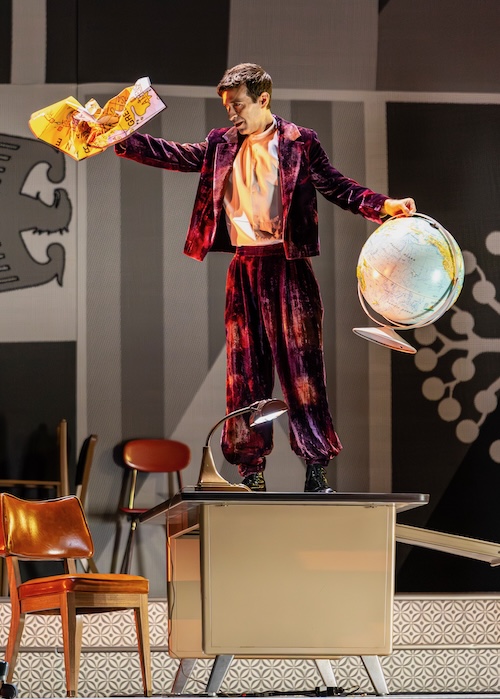
Anthony Roth Costanzo as Farnace in “Mitridate.” Photo: Dominic Mercier
His younger brother and rival Sifare is sung by soprano Meredith Wohlgemuth. Much less volatile than his father or brother, Sifare spends most of his stage time in either despair or angst, torn between duty and love. The trousers role could easily be dramatically flat, but Wohlgemuth brings a vividly characterized personality to the role—anxious when alone, stubborn to Farnace, supplicating to Mitridate.
Her soprano never sounded strained or harsh and easily carried, whether loud or soft, high or low. Her Act 2 “Lungi da te, mio bene,” a sorrowful farewell accompanied by a luscious horn solo proved a highlight of the evening,. Wohlgemuth conveyed both great tenderness as well as ridicule by humoring the audience with several false exits before launching into yet another stanza.
Rounding out the main cast is soprano Brenda Rae as Aspasia, who replaced the previously announced Lauren Snouffer after the latter’s last-minute withdrawal from the production. Rae was slower to settle into her role than the rest of the cast, somewhat understandably considering the circumstances.
Her demanding opening aria “Al destin, che la minaccia” was too quiet in the low register and her tone occasionally thin at the very top. Fortunately, by the second half, Rae had found her footing, and sang with more carrying power even at pianissimos. Her Act 2 duet (the only one in the opera) with Wohlgemuth “Se viver non degg’io” was evenly balanced between the two singers.
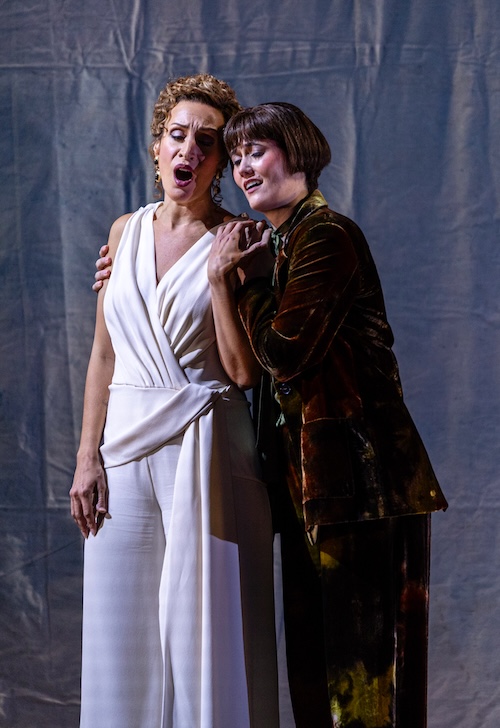
Brenda Rae as Aspasia and Meredith Wohlgemuth as Sifare in “Mitridate.” Photo: Dominic Mercier
Voices of reason were provided by Sarah Coit and Nola Richardson. Coit as the military advisor Arbate countered the explosive antics of Mitridate and his hotheaded sons with a voice as steady as her attitude. Richardson as Ismene sang sweetly, with a ringing soprano that left the audience wishing for more than her two arias.
Tenor Minghao Liu sang the role of the Roman officer Marzio, who patiently puts up with Farnace’s antics until the time comes for Rome to invade Pontus, when he turns the tables in his sole aria “Se di regnar sei vago.” Liu’s voice is confident and showy, making the most of his brief time in the spotlight.
Stage direction by Emma Griffin, also responsible for Wolf Trap Opera’s recent Eugene Onegin, crafted an overall entertaining and satisfying production despite some confusing visuals. The scenic design by Kaye Voyce sets the action against a vaguely modern office lined with flags and accessorized with more globes than one thought possible. Costumes by Voyce and hair and makeup by Tommy Kurzman dresses the main cast in a combination of military chic and tacky luxury, with a small army of supernumerary crime-scene cleaners serving as servants and soldiers throughout.
Lighting by Masha Tsimring is bold, making use of both saturated colors and stark monochromes. Corrado Rovaris leads the orchestra with a fine, steady hand. The ensemble was balanced throughout, with particularly impressive quiet dynamics, and the concerto-like interplay between instruments and singers dotted throughout the score were a treat to hear.
Mitridate runs through September 13 at the Academy of Music. www.operaphila.org
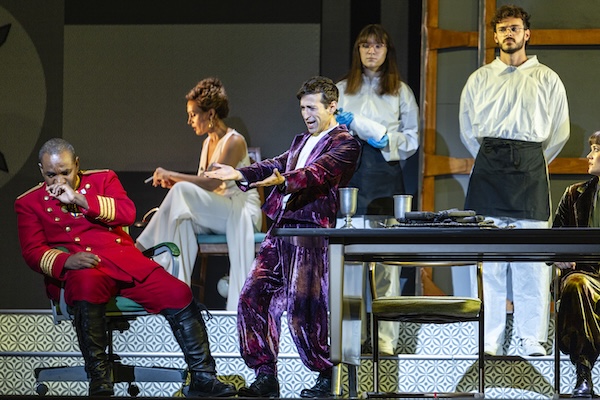
Photo: Dominic Mercier
Leave a Comment