Lintu marks return to Baltimore Symphony with magisterial Sibelius
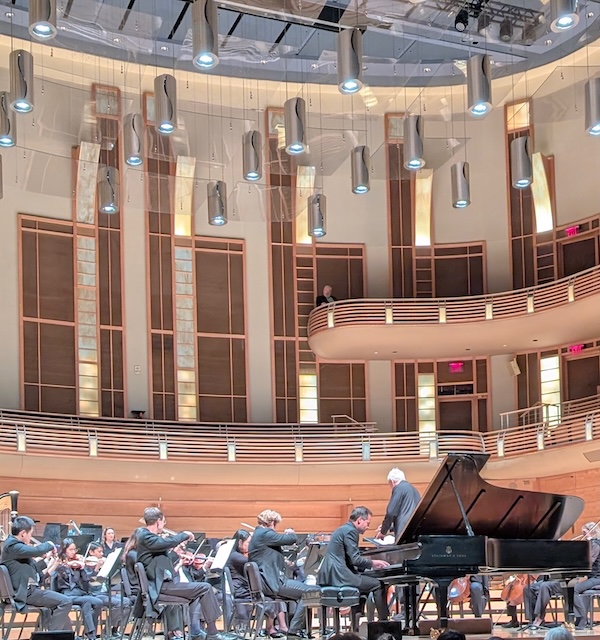
Francesco Piemontesi performed Beethoven’s Piano Concerto No. 4 with Hannu Lintu conducting the Baltimore Symphony Orchestra Saturday night at the Music Center at Strathmore. Photo: C. Downey
Hannu Lintu returned to the podium of the Baltimore Symphony Orchestra for the first time in eight years this week. The Finnish conductor, who holds full-time posts in Finland and will become music director of the Singapore Symphony Orchestra this fall, noted the occasion before leading a concert Saturday night in the Music Center at Strathmore. “You look the same,” he quipped to the audience, an unspoken reference to his own much whiter hair.
Before the pandemic, Lintu appeared regularly as guest conductor with both the BSO and National Symphony Orchestra. His wit and erudition, heard in introductory remarks about the music, and his interpretations have been missed. The excellent program featured works of two Finnish composers, Jean Sibelius and Kaija Saariaho, who are his specialties.
The former composer’s Night Ride and Sunrise, a quirky tone poem from 1908, opened the evening. Supposedly inspired by Sibelius’s late-night sleigh ride from Helsinki to his home in Kerava, the piece begins with an obsessive uneven triplet figure running through the strings. Lintu helped shape this section in mostly soft dynamics, creating a steady sense of movement, intense rather than forbidding.
The strings distinguished themselves with rich, shining tone in the hymn-like transition to the sunrise conclusion. The horn section shimmered resonantly as the first glow of the sunrise appeared, followed by a brilliantly marshaled crescendo. Glints of triangle led to an expansive addition of the remaining brass, complete with some odd harmonic turns in the final exchanges with the strings to cap an excellent rendition of this rarely heard piece.
Beethoven’s Piano Concerto No. 4 suited the strengths of soloist Francesco Piemontesi, more than the Rachmaninoff he played in his NSO debut in 2019. The Swiss-Italian pianist gave the piano-only opening of the first movement an air of mystery. Hantu and the BSO responded in kind, as the orchestra took up the theme in a distant key. Lintu encouraged rubato freedom throughout the first movement.
Piemontesi showed an admirable delicacy of touch, the runs pearly and the trills handled with ease. Near the end of the movement he played the most commonly used cadenza, penned by Beethoven, with a sense of the unexpected, as if it unrolled like his own improvisation.
Lintu elicited an angry, buzzing energy from the orchestra’s forceful unison phrases in the slow movement, answered by poetic reflections from Piemontesi. The third movement, paced rapidly, retained the lovely phrasing the soloist applied to the previous two. Standing out from the bouncy orchestral sound were gorgeous sectional contributions from violas and cellos, seated by Lintu with the former section on the outer edge of the ensemble.
Piemontesi offered a single encore, a calm and tender rendition of Brahms’ Intermezzo in E-flat major, the first piece in his Op. 117. The detailed voicings of melodies and counter-melodies in this gentle piece stilled the room as if all were holding their breath.
After intermission came more Finnish music, beginning with Saariaho’s Ciel d’hiver, an arrangement for smaller orchestra of the second movement of the late composer’s Orion. Lintu explained that the constellation Orion is seen in Finland during the winter months, drawing a programming parallel with the Sibelius tone poem heard on the first half. Lintu paced the work expensively, as the BSO created an eerie, mostly still soundscape that shivered with color. Worthy solo playing came from piccolo and cello, among others.
Sibelius’ Seventh Symphony, his last completed example of the genre, rounded out a packed but entrancing program. Lintu led the work with a confident understanding of the seemingly endless tempo fluctuations embedded in the score. In a single movement, the fantasy-like structure popped off the page in this quicksilver reading. Special recognition must go to the trombone solo, on the calming theme Sibelius marked with the name of his wife, Aino. The full complement of brass gave this theme even greater nobility, leading to a majestic conclusion.
The program will be repeated 3 p.m. Sunday at Meyerhoff Symphony Hall. bsomusic.org
Leave a Comment