Abduraimov offers relentless intensity in unsubtle CMM recital
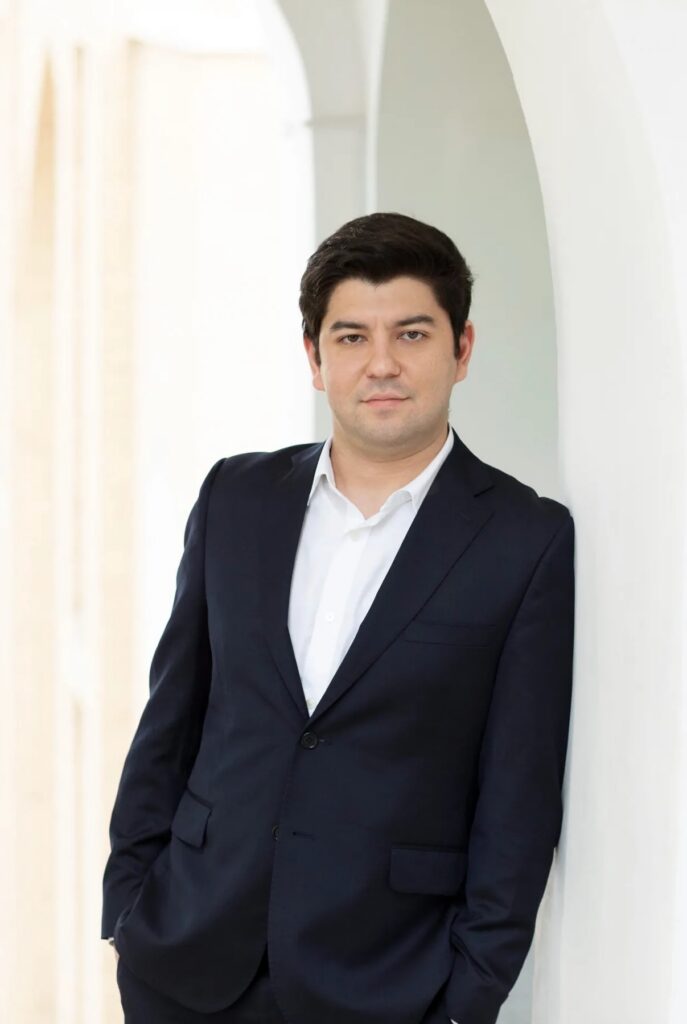
Pianist Behzod Abduraimov performed a recital for Chamber Music Maryland Sunday in Ellicott City. Photo: Evgeny Eutykhov
Behzod Abduraimov has shown off his virtuoso credentials in recent concerto appearances with the National Symphony Orchestra. Returning to the Chamber Music Maryland series Sunday evening, the Uzbek pianist played the most daunting pieces on this program with imperious acumen and ferocity. The concert, rescheduled from April 18 because of illness, took place at First Evangelical Lutheran Church in Ellicott City.
Much like Abduraimov’s debut on the series, back when it was still called Candlelight Concert Society, the less challenging fare sometimes failed to come to life. The Intermezzo in B Minor, the first piece in Brahms’ Vier Klavierstücke, Op. 119, had the needed sense of melancholy, taken at a slow tempo and with heavy rubato. Abduraimov moved too hastily through the other three pieces, however, not without some admirable moments of delectation, but tending to overdo the bombast in what were the last solo piano works Brahms composed.
A similar approach marked Abduraimov’s interpretation of Debussy’s Suite bergamasque. The centerpiece of the four-movement work, “Clair de lune,” had just the right hushed, ethereal quality. Subtle gradations of sotto voce dynamics provided more than enough variety and interest, as did elegant voicings and fluidity of pacing. Of the other pieces, only the Menuet felt unrushed and examined by Abduraimov in the same way. Although played skillfully, both the Prélude and Passepied came and went without much to notice.
By contrast, the technical prowess required in the remaining music on the program played more to Abduraimov’s strengths. Carl Czerny’s Variations on a Theme by Rode are based on a tune, Jacques Rode’s “La ricordanza,” that hardly merits a second thought. The appeal of the variations comes in the Lisztian excesses Czerny applied, which Abduraimov met with bravura.
Abduraimov’s right hand, always light and with legato clarity, flew through the ornate decoration of the first variation, moving even faster and more evanescently in the third variation. Not happy with the already fast tempo in the latter variation, Abduraimov even accelerated, adding to the dizzying accomplishment. Fireworks continued in the fifth variation and the closing cadenza and coda.
Not surprisingly, the selection by Czerny’s most famous student, Franz Liszt, occasioned even greater virtuosity. The “fantasia quasi sonata” known as Après une Lecture du Dante, rife with dramatic tritones and dissonant keening, teeters on the trashy side of Liszt’s output. Unlike Zlata Chochieva, who took the piece more seriously in her interpretation last month, Abduraimov leaned into its kitschy sense of drama.
Abduraimov battered the Steinway so uninhibitedly that a technician came to the stage at intermission to correct the tuning. The sting of the biting tritones, hammered with force, and the thunderous octaves resonated in the somewhat echo-prone acoustic. The soft angelic theme, representing either the reasoning voice of Virgil or the blessing of Beatrice, provided a glowing contrast.
Nothing quite prepared the ear for the last chapter of this heavy-hitting program, Stravinsky’s Three Movements from Petrushka. Abduraimov created a sense of manic obsession in the steely fortitude of his attack, pointed and at blindingly fast tempos in the opening “Danse russe.” The bitonal Petrushka theme, taken with quicksilver unpredictability, added to the sense of insanity in “Chez Pétrouchka,” balanced by the tragic, ultra-slow dance of the Ballerina, played with some lovely voicings.
The crazy, teeming textures of the concluding movement, “La semaine grasse,” had a truly orchestral scope, not stinting in tempo even as the score had to be notated on as many as four staves. Abduraimov marshaled every seemingly impossible technical element—the whirring parallel thirds, the octave glissandi in the left hand, and the chromatic vagaries—into a driven blur of lunacy.
Taking pity on the piano and on the audience’s nerves, Abduraimov turned to Rachmaninoff’s Prelude in G Major (Op. 32, no. 5) for an encore that offered a welcome sense of final benediction.
The Parker Quartet plays Beethoven’s String Quartet No. 11, Wiancko’s Strange Beloved Land, and Brahms’ String Quartet No. 3, 7:30 p.m. May 30. CMM’s 2026-2027 season will feature the Quatuor Danel, harpsichordist Jean Rondeau, and pianist Piotr Anderszewski, among others. chambermusicmaryland.org
Leave a Comment