Quigley closes first Opera Lafayette season in style
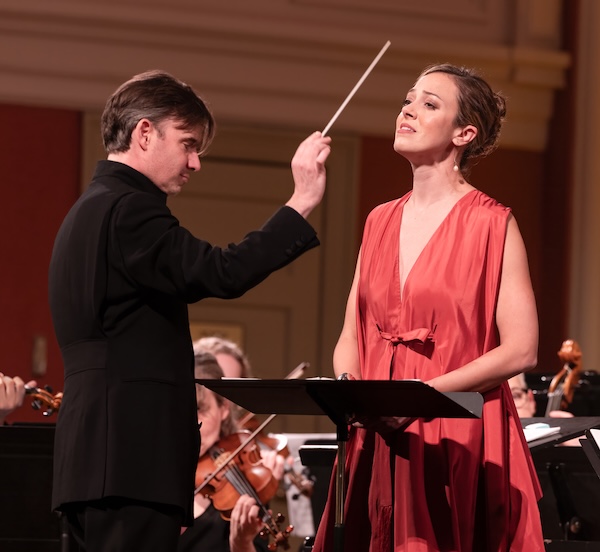
Patrick Dupre Quigley conducted the Opera Lafayette Orchestra with guest soprano Lauren Snouffer Thursday night. Photo: Jennifer Packard
Patrick Dupre Quigley has come to the end of his first season as artistic director of Opera Lafayette. After a staging of Purcell’s Dido and Aeneas and a chamber-sized recital program earlier in the season (the latter led by Nicholas McGegan), Quigley featured the Opera Lafayette Orchestra in a concert Thursday night at the Sixth and I Historic Synagogue. Soprano Lauren Snouffer contributed solo vocal works between orchestral selections.
Snouffer, who had a striking Santa Fe Opera debut in a 2023 production of Monteverdi’s Orfeo, sang with an incisive tone, muscular runs, and occasional high-flying fireworks. The American soprano sounded best in arias with the greatest melodic and harmonic interest, mostly those on the first half. These selections, by Gluck and Johann Christian Bach, were conceived for castrati, and tested Snouffer’s voice in range and fortitude.
“Se mai senti spirarti sul volto,” extracted from Gluck’s early opera La clemenza di Tito, showcased Snouffer’s bold sound, consistent from top to bottom. The main slow section proceeded elegantly, with gentle strings like a soft, blowing breeze. A faster B section, short and more forthright, led to a da capo repeat, with limited ornamentation and a brief cadenza from Snouffer. The oboe solo played by Dan Bates made a fine complement to her voice.
Even more striking was the concert aria “Ebben si vada…Io ti lascio,” by J.C. Bach. This dramatic scena veers from accompanied recitative, to arioso, to full-blown aria. Here the obbligato oboe part was so prominent that Bates stood next to Snouffer, interweaving his part skillfully with hers. An additional sonic delicacy came from the gentle sound of the fortepiano, played for this piece only by Andrew Rosenblum.
Between the two came the instrumental highlight of the evening, a taut and graceful rendition of Haydn’s Symphony No. 63. Quigley, choosing a lively but not rushed tempo for the first movement, helped the small ensemble make vibrant contrasts between piano and forte dynamics. Horn players Nate Udell and Rachel Nierenberg helped boost the latter with some outdoorsy bombast, as did the bassoon of Anna Marsh. (The staircase railings at Sixth & I had to be removed to provide enough stage space for the full orchestra.)
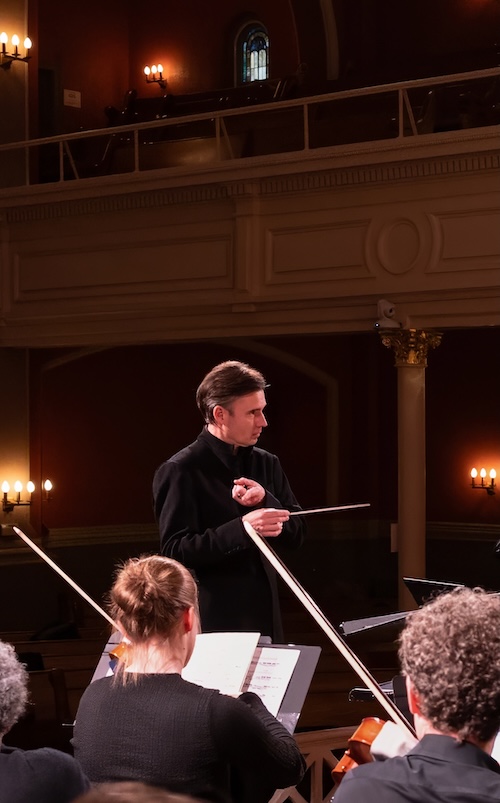
Photo: Jennifer Packard
The second movement, repurposed from Haydn’s incidental music for a play called Les Trois Sultanes, gave the symphony its nickname (“La Roxelane”). Strings and winds alternated in this charming double variations, including a lovely cameo by flutist Joe Monticello. A lilting Minuet, including a cheery Trio featuring oboist Dan Bates, and a crisply active Finale rounded out a superb outing for this orchestra of period instruments.
Two lesser-known women’s compositions made up the concert’s second half, of great interest in terms of rarity, if not always musical ingenuity. Maria Antonia Walpurgis, Electress of Saxony, stands among the small group of musically inclined monarchs that includes Frederick the Great. In addition to composing the opera Talestri, Regina delle Amazzoni, among other vocal works, she also sang in the performances of her compositions.
That opera’s two-movement overture proved pleasant enough, as did the single aria performed by Snouffer, “Vado; ma il core di Dio!” Lacking in harmonic invention and melodic surprise, both excerpts seemed rather repetitive and uninspired by comparison to what was heard on the first half. It is hard to imagine commercial viability for this composer, without her noble name and wealth to ensure performances.
Marianna Martines is a more interesting case. She grew up in a household that included at various points the poet Metastasio and the young Joseph Haydn. Because of her father’s connections, she became a celebrated keyboard player and singer, likely performing most of her compositions herself. Although she never composed an opera, her oratorios and cantatas are mostly set to the poetry of her mentor, Metastasio.
Martines’ two-movement Overture in C Major did not measure up to Haydn’s savvy handling of the orchestra—who does?—but the scena Berenice, a che fai revealed Martines as a composer who knew how to mine the dramatic possibilities of the voice. Snouffer gave emotional verve to the accompanied recitatives, using the musical contrasts to personify the character’s distress. Although the top end of her voice had seemed somewhat constrained all evening, she interpolated a powerful high note into the cadenza near the end of the concluding fast aria.
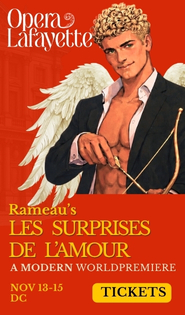
The program will be repeated 7:30 p.m. Saturday at Merkin Hall in New York City. Next season Opera Lafayette will perform Rameau’s Les surprises de l’amour, as well as programs devoted to Dowland and opera excerpts set to Metastasio’s La clemenza di Tito. operalafayette.org
Leave a Comment