Simon’s NSO premiere disappoints while Noseda’s splendid Brahms continues
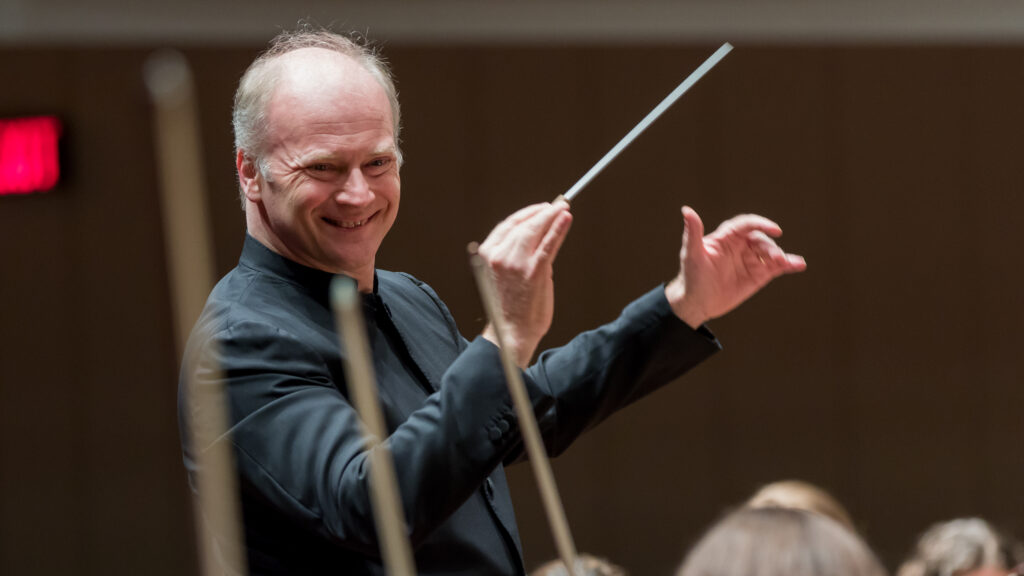
Gianandrea Noseda conducted the NSO in music of Brahms, Schumann and Carlos Simon Thursday night. File photo: Scott Suchman
The National Symphony Orchestra continues to deliver taut and sensitive performances week after week. Even with the shutdown of their Kennedy Center home planned for this summer, the NSO stood up admirably in comparison to two top recent visiting ensembles, the Chicago Symphony Orchestra and the Vienna Philharmonic. Thursday evening’s program, conducted in the Concert Hall by Gianandrea Noseda, showed continued resolve in the face of the latest bad news.
At the end of last week, NSO executive director Jean Davidson announced her departure this spring, to take a position in California. Upon cutting short her tenure, which began in 2023, Davidson spoke publicly of her frustration with the turmoil at the Kennedy Center under the Trump administration.
Noseda opened the evening with the Overture from Robert Schumann’s incidental music for Lord Byron’s Manfred. From the loud, agitated chords that launched the piece, Noseda and his musicians invested this music with manic energy. Noseda expertly threaded the needle in terms of the roiling tempo adjustments, an approach that captured the voluble nature of Byron’s hero, even though the score is not among Schumann’s finest.
Next came the world premiere of a new Double Concerto Suite by Washington-born composer Carlos Simon, the NSO’s composer-in-residence since 2021. Violinist Hilary Hahn and cellist Seth Parker Woods withdrew from this debut performance last month, without giving a reason, another in the onslaught of cancellations at the Kennedy Center.
NSO associate concertmaster Ying Fu and assistant principal cellist Raymond Tsai, nearing the end of his first year with the orchestra, stepped in to save the day. (Their principal counterparts, Nurit Bar-Josef and David Hardy, took the solo parts in the Brahms Double Concerto in January.) Simon has described the piece as having no program, only a connection to the baroque suite in its assortment of five dance-inspired movements.
In the first movement came the clearest allusion to a baroque model, enough of a melodic snippet to draw attention but not enough to be easily identified. Augmenting the baroque sense of rhythmic propulsion, Simon added an invigorating pulse in the marimba, with the two soloists generally playing together in thirds or sixths. The second movement, an intense passacaglia that began in the double basses, featured Tsai’s honeyed solo tone, later joined by Fu and leading to a cadenza section.
The brief third movement drew on metallic percussion and shimmering woodwinds to create a mystical effect. Simon, whose pallid orchestration underwhelmed over the course of this half-hour piece, focused finally on the brass in the fourth movement, where they served up some vital big-band sounds. Hints of Stravinsky’s more dynamic experiments with neo-baroque style came through as well.
A final note of American modernity came in the fifth movement, an evocation of Delta blues. Tsai tended to blend into the background throughout the suite, while he and Fu approached the bends and blue notes of this movement in rather square fashion. Although the orchestra and soloist played with admirable virtuosity otherwise, this new suite seemed to collapse a bit under its own weight as the melodic ideas ran thin.
The high point of the concert came with a magnificent rendition of the Third Symphony of Brahms, a work with an important Washington connection, since the composer’s autograph manuscript is preserved at the Library of Congress. Noseda avoided the temptation to press this shortest of Brahms symphonies for maximum emotional impact, preferring the more Brahmsian tendency toward emotion smoldering beneath the surface.
The first movement opened broadly but then receded into a more interior second thematic area, making its fullest statements during the development section and coda. The symphony’s impact comes in the paired slow movements at its heart: gorgeous woodwind textures in the second movement, centered on melancholy clarinets, with a veiled halo of string sound in the middle section. The third movement, an anguished waltz, traded its poignant theme beautifully from cellos to violins and finally to the spotless horn playing of Abel Pereira.
In the Finale, Noseda held back sound in reserve as he carefully built to the triumphant climax, where the opening theme thought to represent Brahms’ motto returned memorably. That decision, in turn, helped prepare for the chromatic strings and Wagnerian brass that settled into the elegiac ending of the work, a musical effect that left the audience in stunned silence.
The program will be repeated 8 p.m. Friday and Saturday. kennedy-center.org

Posted Mar 13, 2026 at 11:23 pm by MacroV
I look forward to the Saturday performance, but I hope your reference to the Chicago Symphony was just to say the NSO is playing very well, and not throwing shade at the Chicago Symphony. Because they were astounding. I hear the NSO and Baltimore regularly, and they are both wonderful; the level of orchestra playing around the world these days – and in the DMV – is outstanding; we are really fortunate to have two world-class orchestras playing regularly in the DMV. But the CSO – admittedly in tour form – is just in another class. I can’t even explain why, they just are.
I like the pieces I have heard to date of Carlos Simon, and his “Amen” for band is terrific. So I hope I will be disagreeing with you about his new work.
Posted Mar 20, 2026 at 10:52 am by Jaime Herrera
I enjoyed reading this very descriptive review – and thank you for not praising a contemporary work simply for the sake of promoting new music. (Also, thank you for calling the Kennedy Center the Kennedy Center, which it should always be called.)
Posted Jun 27, 2026 at 7:03 pm by Brian Knight
I found this concert review very helpful and informative because it gave me some insight into Noseda’s conducting of Brahms and Schumann. It will help enormously in deciding whether to invest in Noseda’s new CD set of Brahms’s symphonies, with the Zurich Opera Orchestra.