McGill, Fairfax Symphony provide compelling advocacy for Leshnoff premiere
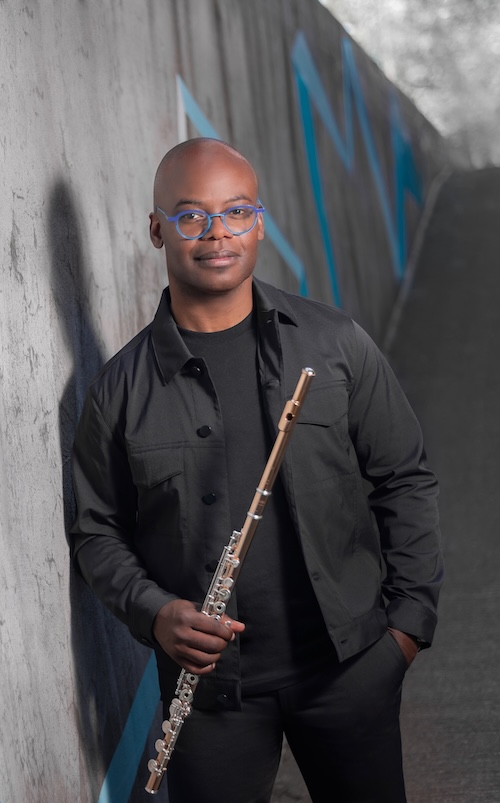
Demarre McGill was the soloist in the world premiere of Jonathan Leshnoff’s Flute Concerto No. 2 with the Fairfax Symphony Orchestra Saturday night. Photo: Carlin Ma
Baltimore-based composer Jonathan Leshnoff received a commission for his Flute Concerto no. 2 from his longtime friend Dr. David J. Brown, with the request that Leshnoff capture the African-American experience in the concerto. Leshnoff, who is white, set himself the challenge of understanding that experience well enough to turn it into his own personal expression.
The resulting work received its world premiere on Saturday night at the George Mason Center for the Arts, with soloist Demarre McGill and the Fairfax Symphony Orchestra under the baton of music director Christopher Zimmerman.
Although African-American music, in its many forms, is omnipresent in the United States, Leshnoff’s concerto contains no obvious thematic or stylistic references to it. This is not a criticism—better to avoid incorporating African American music than to include it ham-fistedly, as in many well-meaning classical compositions.
So the first movement, which depicts (in Leshnoff’s words) “the collective quest for equality and the soul of the collective African American,” opened with a few measures of undulating music in low strings and winds. This yielded to McGill playing a meditative, yearning theme, built on a four-note rising and falling motive, that dominated the movement. Leshnoff skillfully varied the pitches of the motive and the harmonies and textures around it, so that the music sounded like the ebb and flow of deep contemplation. The undulating music returned a few times to give McGill a breather and to further spur the development.
McGill played the theme and its variants with a coolly lustrous tone, thoughtfully shading the music with different colors and phrasing that kept it feeling both fresh and unresolved, finding the pathos and the logic in the music. Zimmerman made sure the orchestra allowed McGill’s lines to be heard easily, and the orchestra provided sensitive accompaniment.
The second movement describes “the African American struggles, from the slave trade to the present day” — a lot to take on, especially with a solo instrument that does not lend itself to forceful utterance. Leshnoff had McGill spent most of his time in this movement playing disconnected notes at a very fast pace, requiring incredible breath control, which did not appear to challenge the soloist; indeed, sometimes he went a little faster than his orchestral accompaniment. The notes McGill played added up to angular, unsettled music, particularly as Leshnoff cycled sections of the orchestra in and out of the accompaniment. The resulting music was a bit punishing to listen to, which was likely the point.
Eventually, the music found a place of rest in a rhapsodic melody, which in turn led to a flute solo, not showy but arresting in McGill’s hands. A brief final movement followed, portraying “the perseverance, resilience and ongoing hope of the African American community” with a beatific melody from McGill, surrounded by luminous strings and woodwinds, a closing that felt earned after what preceded it.
Overall, the concerto promises well for Leshnoff’s upcoming stint as the Baltimore Symphony Orchestra’s composer-in-residence for the 2026-7 season — area audiences will have a lot of opportunities to hear Leshnoff’s melodic, thoughtful, and compelling music.
Another Second Flute Concerto, this one the D major by Wolfgang Amadeus Mozart, opened the program. McGill’s day job is principal flute of the Seattle Symphony, but he sounded every bit the virtuoso soloist in Mozart’s galant melodies, his tone shimmering brightly as he navigated all the concerto’s figures and ornaments with elan and without apparent struggle.
McGill made the first-movement cadenza a particular highlight, subtly pushing and pulling the melodic line to heighten the drama; the slow movement featured beautifully sustained flute lines, and McGill played with perfect zippy rhythm in the finale, selling Mozart’s jokes admirably. Zimmerman led the Fairfax SO in sparkling, sprightly accompaniment that went hand-in-glove with the soloist.
After intermission, Zimmerman led the orchestra in a performance of Felix Mendelssohn’s Symphony no. 4, the “Italian,” that burst with energy—sometimes too much so.
In the first movement, the timpani overshadowed the rest of orchestra, and the scampering strings occasionally got at cross purposes. Yet the giddy rush of this music came through, even more so in the remainder of the symphony. The strings provided some deft melodic turns in the second movement, and Zimmerman took the third movement at a fast stride that brought out its sunniness.
The ensemble saved the best for last — the Saltarello finale raced along seamlessly, with particularly stylish playing in the cello section, as Zimmerman and the orchestra pressed to the final chord.
The Fairfax Symphony Orchestra next presents “Rick Steves’ Europe: A Symphonic Journey,” 5 p.m. March 29. fairfaxsymphony.org
Leave a Comment