Cello times two for another bracing CMSLC quintet program at Wolf Trap
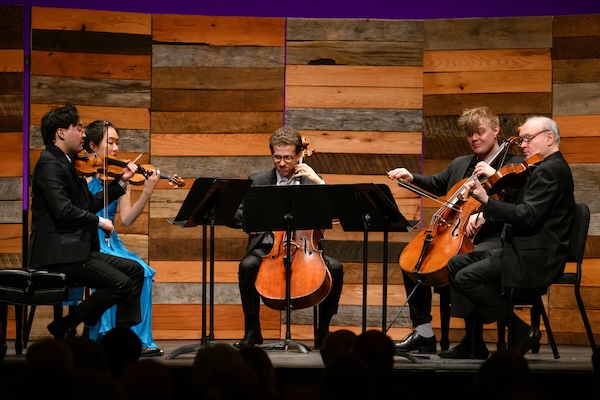
The Chamber Music Society of Lincoln Center performed Friday night at Wolf Trap. Photo: Rich Kessler
The best concert programming often considers the season-long arc as well as individual events. Such was the latest offering from the Chamber Music Society of Lincoln Center in Wolf Trap’s series. To complement the two-viola string quintet program heard last November, Friday night’s concert counter-punched with examples of the two-cello variety. Again parallel to the previous concert, some of the composers featured were themselves cellists.
Luigi Boccherini, a formidable cello virtuoso, favored the cello quintet format, composing well over one hundred of them among a vast array of seldom heard chamber music. His String Quintet in G Minor was the last of six in his Op. 29, composed for his patron, the Infante Luis Antonio Jaime of Bourbon, brother of the Spanish king, in 1779. (It is not the quintet containing the refined Minuet that is Boccherini’s most famous work.)
Julian Rhee displayed impeccable tone and technique on the flowery first violin part, perfectly in tune up and down his range. Jonathan Swensen took the first cello part, likely meant for Boccherini himself, gliding confidently to the very top of the A string in the first movement and executing complex figuration in the Minuet’s Trio section. The ensemble gave melting pathos to the mournful harmony of the third movement, followed by a joyous concluding Rondo, complete with a charming music-box coda.
Rhee returned to the stage with violist Paul Neubauer and cellist Nicholas Canellakis for Beethoven’s String Trio in G major. This first trio in the composer’s Op. 9 from 1798, showed the young composer coming into his own stylistically. Beethoven treated the three instruments as equals, making technical demands on all of them, and this trio of well-matched musicians shaped each of the four movements with grace and humor.
Once again, Rhee impressed with a solid technique and expressive musicality, especially in the outer movements. The plush slow movement featured the three instruments sounding as one, with poignant phrasing. Rhee did tend to rush ahead of his colleagues at times, especially affecting the third movement, a compact Scherzo with some Haydnesque comic moments, and the concluding Presto, a madcap finale.
Swensen and Canellakis opened the second half with a rarity, the Sonata in G major for two cellos by another 18th-century cellist-composer, Jean-Baptiste Barrière. In the first movement, the two cellists did their best to sound like identical twins, continually trading melodic and accompanying roles, often from one measure to the next. This compositional sleight of hand was so deft that one questioned if they somehow switched parts on the repeats.
Swensen, on first cello, made the most of the second movement, an extended tragic aria accompanied by Canellakis. Here and in the other movements, Swensen augmented his part with ornamentation, sometimes quite ornate and in consummate baroque style. Both cellists were back to their contrapuntal tricks in the third movement, articulating the overlapping lines with elegant clarity. Swensen took the opportunity of the score’s Adagio pause near the end to add another sparkling cadenza.
Danbi Um, who had played second violin in the Boccherini quintet, got her moment in the sun as first violinist in the final work, Alfredo D’Ambrosio’s Suite for Strings. The five musicians aimed for full-throated romantic bombast in the first movement, which did not suit Um’s more subtle musical style. She came into her own in the other three movements, especially the playful Scherzo, with its gestures of physical comedy and pizzicato delicacy.
D’Ambrosio, who was also a violinist, swerved occasionally into cheesy sentimentality, as in the slightly precious third movement, a Berceuse. Canellakis, who played the first cello part (the seating was erroneously reversed in the program), crooned sweetly when the lullaby tune went softly to the bottom part of the texture. The composer understood the coloristic advantages of this bass-heavy quintet format, with Neubauer and the two cellists often providing a dark-hued somberness in their featured tableaux.
The Imani Winds perform music for wind quintet by Coleman, Aho, D’Rivera, Wonder, Say, and Shaheen 3 p.m. February 8. wolftrap.org
Leave a Comment