Soprano Forsythe sparks National Symphony’s lean and protean “Messiah”
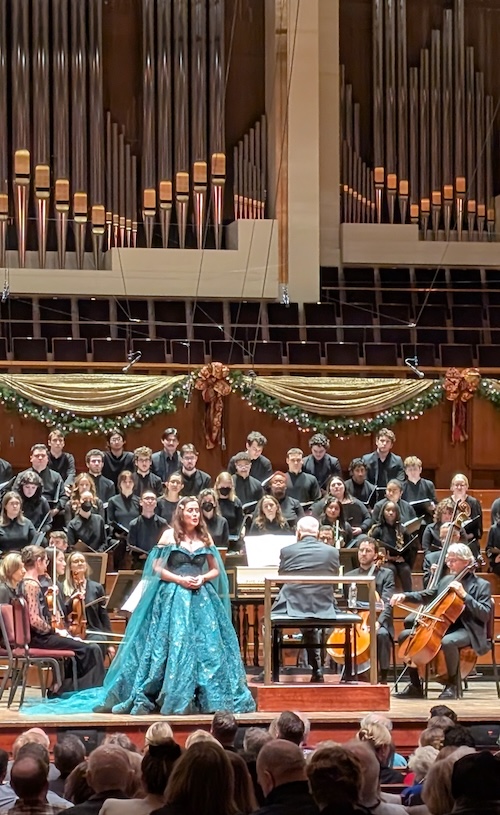
Amanda Forsythe was among the soloists in the NSO performance of Handel’s Messiah, led by Ton Koopman Thursday night at the Kennedy Center. Photo: C. Downey/WCR
Reviewing Messiah can feel like a dreaded critical chore every December. After countless hearings of Handel’s rightly celebrated but woefully over-exposed oratorio, the experience of surprise during the last assignment of the year is most welcome.
Credit goes to celebrated early music conductor Ton Koopman, who led a historically informed performance with the National Symphony Orchestra Thursday night in the Kennedy Center Concert Hall.
Per tradition, every year’s Messiah is different at the NSO, based on the choice of guest conductor, local chorus, orchestration, and selection of pieces. As expected, Koopman led a pared-down ensemble of under thirty string players, all playing senza vibrato. William Neal, seated at a baroque chamber organ, contributed most of the continuo realization, excerpt for a few recitatives and extended cadenzas, where Koopman himself played from a harpsichord.
(The instrumentation made for another unusual rendition of the Star-Spangled Banner, now mandatory at the start of every NSO concert. Concertmaster Nurit Bar-Josef led this early music version of the national anthem, with the two oboists providing the flute flourishes.)
The surprise came in the selection of pieces for the soprano soloist, Amanda Forsythe. In the middle of her accustomed Christmas sequence of pieces near the end of Part I, Koopman inserted the alternate version of “But lo, the angel of the Lord,” composed by Handel for the 1743 premiere of Messiah at London’s Covent Garden. The composer crafted it for the voice of Kitty Clive, the enterprising English soprano tapped for his new oratorio company in London.
Clad in an extravagant sparkling green gown with trailing veil over her arms, Forsythe made a full diva effect for the evening. That little alternate arioso became a moment of chamber intimacy with Koopman on harpsichord and David Teie on the virtuosic cello solo. The other soprano pieces served as vehicles for Forsythe’s flute-like top range, complete with operatic embellishments and cadenzas in “Rejoice greatly” and “I know that my redeemer liveth.”
Confident in her abilities, Koopman also had Forsythe sing “How beautiful are the feet,” complete with an unusual middle section (“Their sound is gone out”). As part of the restoration of the middle section of Part III, omitted in most performances, Forsythe ended with a showpiece, the aria “If God be for us,” decorated with trills and other vocal whiz-bangs. (This went with Koopman’s overall shaping of the oratorio, removing substantial sections of Part II, to deemphasize the texts dealing with Christ’s passion.)
Tenor Kieran White added a similar level of ornamentation in his pieces, showing off elegant melismatic clarity in his opening pairing of “Comfort ye” and “Ev’ry valley.” The slender orchestral sound, controlled with care by Koopman, never overpowered his lyrical voice. One of the big tenor arias, “Thou shalt break them,” was replaced with another Handel alternate, a much more compact recitative.
Countertenor Maarten Engeltjes had the vocal range for most of the alto solos, with some occasional stridency and paleness. On the signature piece that Handel wrote for the contralto Susannah Cibber, however, a countertenor just will not do. Bass-baritone John Taylor Ward interpolated some impressive low notes in his solos, although his overall volume seemed underpowered for “The trumpet shall sound,” where assistant principal trumpeter Michael Harper outshone him.
For this baroque-sized version, the University of Maryland Concert Choir was the obvious choice for Koopman. The small ensemble of youthful voices, prepared ably by Jason Max Ferdinand, gave vitality and clarity to the many choral numbers, some of which are not familiar, like Part III’s “If God be for us.” Koopman’s conducting style, incisive and sometimes leaning toward fleet tempi, suited this group admirably.
________
In an oddly timed move, the Kennedy Center board voted Thursday morning to rechristen the venue as the Trump-Kennedy Center for the Performing Arts. The move should surprise no one, since President Trump stacked the board with his supporters, who promptly named him chairman of the board.
Without an authorizing vote in the U.S. Congress, however, the name change will be as unlikely to become reality as the renaming of the KC Opera House after Melania Trump, proposed in July to no effect.
On the other hand, the decision may further exacerbate the ongoing audience and donor boycott of the Kennedy Center. The sometimes shocking emptiness of the Concert Hall has reportedly demoralized many NSO musicians, a concern voiced publicly by principal violist Daniel Foster earlier this week.
The program will be repeated 8 p.m. Friday and Saturday, as well as 1 p.m. Sunday. kennedy-center.org
One Response to “Soprano Forsythe sparks National Symphony’s lean and protean “Messiah””
Leave a Comment


Posted Dec 22, 2025 at 7:17 am by William Neil
Dear Charles,
Thanks for the review and mentioning the organ in the article. Koopman was fun to work with. He is a kind man who brings a fresh approach to the stage, whatever the repertoire is. We enjoy collaborating with him.
Given the issues at the Kennedy Center recently, it will be interesting to see if the large attendance at Handel’s choral masterpiece was primarily due to its “pop culture” place in classical music or a hopeful sign of things to come. We shall see.
William Neil, Organist
National Symphony Orchestra