Les Arts Florissants, violinist de Swarte deconstruct Vivaldi’s “Four Seasons” at Library of Congress

Théotime Langlois de Swarte (on right) was the soloist in Vivaldi’s Four Seasons leading Les Arts Florissants Friday night at the Library of Congress’s Coolidge Auditorium. Photo: Shawn Miller/LoC
The resolution to the budget standoff in the U.S. Senate two weeks ago brought a lot of much-needed good news. One excellent result of the end of the federal government shutdown was the belated opening of the Library of Congress’s free concert series, just across from the U.S. Capitol on First Street. The early music ensemble Les Arts Florissants provided a season highlight Friday evening in the intimate acoustic of the Coolidge Auditorium.
This concert also helped mark the esteemed concert series’ centenary in style, after nine previously planned concerts this season had to be cancelled. The program celebrated the 300th anniversary of the 1725 publication of Antonio Vivaldi’s beloved Four Seasons, led by violin virtuoso Théotime Langlois de Swarte. The library owns a cherished copy of that first edition, which was on display in the entrance hall before the concert.
“This is the first time in my life that this happens,” de Swarte enthused in one of his erudite and humorous mid-concert explanations. “To perform this music so close to the original score: it’s right there,” he added with an emphatic gesture. He invited the audience to think back to that first appearance of these four concertos, before this music resounded so constantly in our ears, “in elevators and in advertisements.”
The fifteen musicians on the small stage opened with a look backward, through an arrangement of “Adoramus te Christe,” a liturgical work composed by Claudio Monteverdi for the Basilica of San Marco. Vivaldi’s father played the violin in Venice’s most celebrated church, making the style of this piece one part of Vivaldi’s musical DNA, as de Swarte noted. Benoît Hartoin filled out the largely homophonic chords of the strings with florid arpeggiation on the beautiful Italian-style harpsichord built in 2015 by local builders Thomas and Barbara Wolf.
This set of musical amuse-bouches before the main dish continued without breaks, next including an early Vivaldi Concerto for Strings. Nicknamed “Madrigalesco,” its four brief movements showed the influence of the Venetian vocal style on Vivaldi. Two gentle slow sections, the second of them whisper-soft, introduced scintillating fast movements.
This piece led to an important violinist model for Vivaldi, heard next in a charming Bergamasca by Marco Uccellini. Among its many variations de Swarte traded entwined lines with Les Arts Florissants lead violinist August McKay Lodge, culminating in an extended improvisatory cadenza from de Swarte.
Last came Vivaldi’s Concerto in D Minor, RV 813, one of the first he composed as violin master at the Ospedale della Pietà, a post he assumed in 1703. With some striking similarities to the themes of the “Winter” Concerto, it showed the final stage of the composer’s evolution toward the Four Seasons. In the Andante and Largo movements, de Swarte played with limpid tone, accompanied only by cellist Elena Andreyev and Hartoin. In the fast movements, de Swarte displayed remarkable speed and accuracy, often with quicksilver accelerations.
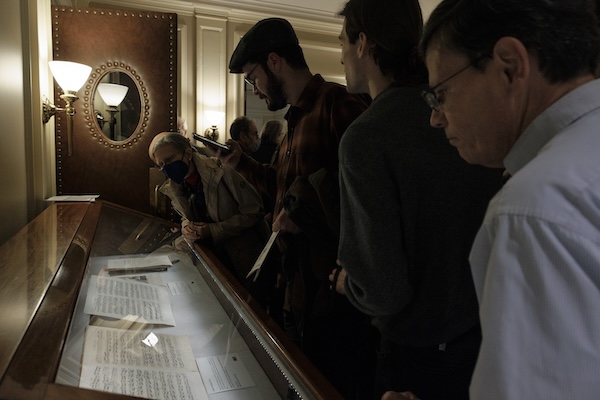
Patrons examine a first edition score of Vivaldi’s Four Seasons from the Library of Congress permanent collection. Photo: Shawn Miller/LoC
The group’s approach to the Four Seasons was informed largely by a close reading of that original score, in terms of articulation and phrasing. The drama came more from explosive dynamic contrasts than sonic effects added to heighten the meaning of the programmatic sonnets explaining what is being depicted. In the “Spring” Concerto, that meant loudly rumbling thunder and freely twittering bird songs in the first movement. Slow movements tended to move briskly, with the viola’s barking dog motif soft-pedaled in “Spring.”
The musicians took considerable freedom with the heat-oppressed, slow parts of the “Summer” Concerto, setting the fast sections at a blistering pace, from which de Swarte still managed to make the cuckoo motif sound from a cloud of arpeggiation. He also added beautiful ornamentation in the slow movement, amid the buzzing insects and violent thunder. The third movement’s hailstorm began softly but quickly grew to thrilling volume and virtuosity.
Vivaldi’s brief, storm-tossed Overture to his opera La fida ninfa, shorn of its raucous hunting horns, opened the second half, with some sounds borrowed from the “Fall” Concerto. The growling of hunting dogs came across most clearly in the third movement of “Fall,” after a reserved slow movement enlivened by harpsichord figuration. The outer movements bristled with virtuosity, from de Swarte and all the musicians, in spite of one early entrance from a cellist.
Before “Winter” came a recent discovery, an unfinished Grave movement from a Violin Concerto in B-flat major. Completed by de Swarte as a technical tour de force, its ostinato bass line, played in plucked notes, led without applause into the similar opening of the “Winter” Concerto. The musical effects of this piece, like howling winds, slippery steps, and chattering teeth proved a vivid warning of the coldest season of the year right around the corner.
The first encore, the high-flying “Con Furia” movement from Charles Avison’s Concerto Grosso No. 6, winked at that English composer, who was also a music critic and apparently quite nasty toward Vivaldi’s music. The audience, not ready to go home, demanded a second encore, a rendition of the third movement of the “Summer” concerto that might have been even faster than the first time around.
Swiss pianist Beatrice Berrut will play pieces by Liszt, as well as transcriptions, by Liszt and herself, of Saint-Saëns’ Danse macabre, Mahler’s Sixth Symphony, and Dukas’s The Sorcerer’s Apprentice 2 p.m. November 22. loc.gov
One Response to “Les Arts Florissants, violinist de Swarte deconstruct Vivaldi’s “Four Seasons” at Library of Congress”
Leave a Comment




Posted Nov 23, 2025 at 8:49 pm by Peter Schulz
I saw the group do the same program earlier earlier this year at George Mason, it indeed was great, and De Swarte is a charming personality as well as a greatviolinist.