Gardner returns to NSO, with searing Britten and Lutosławski
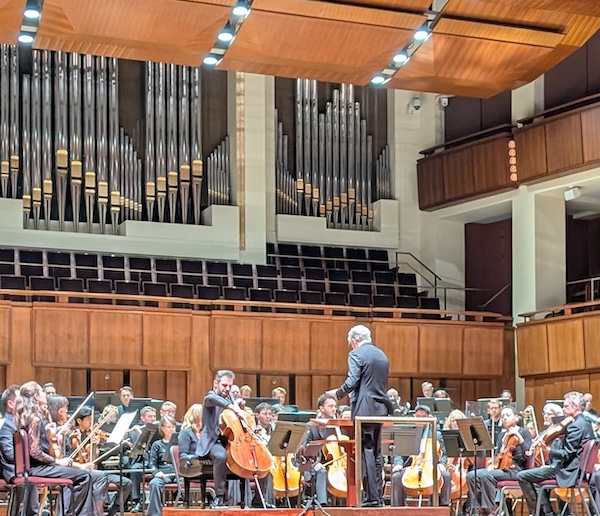
Pablo Ferrández performed Lutosławski’s Cello Concerto with Edward Gardner and the National Symphony Orchestra Thursday night at the Kennedy Center. Photo: C. Downey/WCR
Edward Gardner’s visits with the National Symphony Orchestra always reward the listener with electrifying performances and unusual repertoire. Returning to the podium of the Kennedy Center Concert Hall for the first time since 2020, the English conductor, currently principal conductor of the London Philharmonic, led a pair of rarely heard works from the 20th century and a rousing interpretation of Tchaikovsky’s Fifth Symphony.
Benjamin Britten composed his Sinfonia da Requiem in 1940, part of a commission to honor the anniversary of the Japanese Empire. At the time, Britten and Peter Pears were living in the United States, having felt criticized for their pacifist views. Gardner and the NSO gave a somber weight to the first movement (“Lacrymosa”), a dark-hued funeral march begun with chilling drum strikes. With impeccably clear gestures, he shaped the score into an inexorable wave of sound.
The impetuous second movement (“Dies irae”) felt like a danse macabre cross-bred with an Offenbach galop. Flutter-tongued flutes and a burnished solo for alto saxophone belied the overall sense of violence that permeated most of this section. As the tempo slowed for the final movement (“Requiem aeternam”), set in the major mode, two flutes and bass flute played curling lines in close harmony, setting up this satisfying work’s elegiac conclusion. The Japanese government may have rejected the piece, but it made a fine, belated addition to the NSO’s repertoire.
The NSO’s last performance of Witold Lutosławski’s Cello Concerto dates back to 1980, when Mstislav Rostropovich, who had premiered the work as cellist in 1970, conducted it here. Taking on the fearsome solo part was Pablo Ferrández, making a noteworthy NSO debut. In the unaccompanied first movement (“Introduction”), the Spanish cellist made a striking contrast between the ostinato repeated D, like an impassively ticking clock, and the expansive, lyrical escapades alternating with it. The panoply of technical challenges, including ascents up to perfectly placed harmonics, all came off with remarkable ease of transition.
A blare of trumpets announced the second movement (“Four Episodes”), in which various sections of the orchestra confronted the cellist with brash outbursts. Scenes featured the marimba and other percussion, the celesta, and chattering woodwinds, somewhat reminiscent of Strauss’s Don Quixote in their fantastic variety, although the composer insisted there was no literary program behind the piece. The confrontations grew louder and more hostile, enveloping the soloist in orchestral sound.
Ferrández showed off the warmth of his lyrical A string playing in the third movement (“Cantilena”), now briefly reconciled with the orchestra. In the Finale, faster and more biting, at one point the strings seemed to subsume Ferrández in their unison line, leading to a cataclysm of pummeling brass and berserk woodwinds. The soloist endured to the end, breaking free again and ending on an insistent high note, a gesture back to his opening ostinato.
After such an athletic tour de force, Ferrández rounded out a remarkable debut with a poised, serene Sarabande from Bach’s Solo Cello Suite No. 1. Not only did he weave a placid spell with his restrained phrasing, but he added plausible ornamentation on the repeat of the A section, an impressive baroque flourish.
Gardner made a convincing dramatic arc in his interpretation of Tchaikovsky’s Fifth Symphony. The cyclical theme, heard from the clarinets at the start of the first movement, went from gloomy to heroic by the end of fifty minutes. The NSO played with fortitude and cohesion, seemingly unified by the conductor’s incisive beat. In spite of the many thrilling forte climaxes, Gardner’s careful handling of the triumphant end of the first movement gave no room for the audience to applaud.
The sense of darkness continued in the slow movement, pierced by the moving melody rendered gorgeously by principal horn player Abel Pereira. As other sections took up this tune, most notably the cellos, the symphony’s main cyclical theme intervened in imperious brass sounds. The third movement moved with speed but always with a dancing sense of one beat to measure, shown by broad arms sweeps from Gardner.
Even this fine interpretation could not convince me of the ending of the Finale, which seems to come to a conclusion only to continue in a bombastic coda. Still, the exciting unpredictability of the rubato adjustments led by Gardner made for a powerful conclusion to the evening.
________
The Trump Administration has agreed to let FIFA use the Kennedy Center, free of charge, for nearly three weeks beginning next Monday. Among the events that had to be rescheduled is the next NSO subscription program, planned for December 4 to 6, a season highlight featuring Camilla Nylund and Tomasz Konieczny in Zemlinsky’s Lyric Symphony. Although it was hoped to move this program to next March, it will have to be postponed to a future season, according to sources at the Kennedy Center.
The program will be repeated 8 p.m. Saturday and 3 p.m. Sunday. kennedy-center.org
Leave a Comment