Midori pairs old and new in wide-ranging recital at Sixth and I
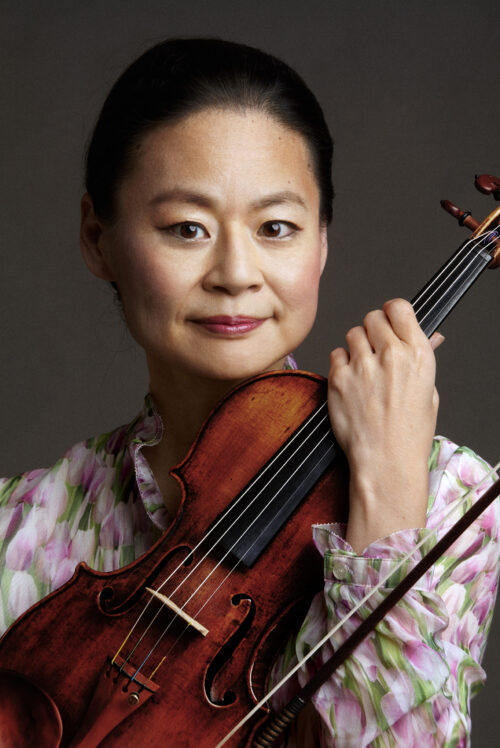
Midori performed Saturday night at Sixth and I, presented by Washington Performing Arts. Photo: Timothy Greenfield-Sanders
Washington Performing Arts continued a decades-long association with Midori on Saturday evening. The Japanese-born violinist gave an intriguing recital, her first presented by WPA since 2022, in the historic synagogue at Sixth and I, partnering with pianist Ieva Jokūbavičiūtė.
This season Washington Performing Arts has relocated all its concerts planned for the Kennedy Center to other venues. One of the advantages of the decision, WPA president Jenny Bilfield said in her introductory remarks, turned out to be increased ticket sales. Since Sixth and I seats more listeners than the Terrace Theater, this sold-out concert also benefited the bottom line.
Midori, who has long championed new music, opened with a piece she commissioned, Resonances of Spirit by Che Buford. The composer was present for the performance, as well as in many of the sounds heard in the pre-recorded track that accompanied Midori’s rendition of the notated solo part.
The commissioner suggested a piece based on traditional spirituals, and Buford attempted to capture the essence of that music rather than quoting it directly. The result is an atmospheric meditation, mostly slow in tempo and loaded with solemn double-stops and drones for the amplified violin. Water imagery played a significant role, in recorded sounds of pouring water and gently roaring surf: in one section, Buford’s recorded voice intoned the words “cooling water.”
Although the work evoked mainly this single mood, the mid-piece addition of an ostinato pattern in the recording added some musical interest, as the violin switched to a more lyrical style. The ostinato, halted by a tap of the musician’s foot on a pedal, gave way to more chanting (inspired by Yoruba spiritual practices) and clashing dissonance, redolent of the pain and oppression often embedded in spirituals.
Pairing new with old, Midori turned next to Beethoven’s Violin Sonata No. 5, known as “Spring” for its sunny opening motif. Now joined by Jokūbavičiūtė at the keyboard, Midori delivered a confident interpretation of the first movement, with an invigorating tempo that felt warm and lively. If the violinist’s tone sometimes turned steely in this older music, the pianist’s touch proved a steady presence, her sixteenth-note runs always pearly and delineated.
Jokūbavičiūtė also came to the fore in the delicate phrasing of the slow movement, which ended with precisely measured trills in both instruments. Rhythmic details locked into place in the brief Scherzo, shaped beautifully by the duo. In the closing Rondo, more piano support would have been welcome, as Jokūbavičiūtė’s tendency to slip into the background worked against her overall musicality.
A longer second half began with Francis Poulenc’s polystylistic Violin Sonata, premiered in 1943 in Nazi-occupied Paris. The first movement featured furious virtuosity from both players, with Jokūbavičiūtė’s velvet touch leading the way toward the sweeter second theme. While Midori’s sound tended toward harshness in the heavier parts of the movement, her legato attack on the quotation of music from the Letter Scene in Tchaikovsky’s opera Eugene Onegin charmed the ear.
Poulenc printed words by Lorca (“The guitar makes dreams cry”) at the start of the second movement of this sonata composed in memory of the murdered Spanish poet. Both musicians captured the elegiac nature of this tribute, complete with allusions to Iberian music. The third movement, powered by Jokūbavičiūtė’s dexterous virtuosity, came to a sudden halt for a tragic cadenza, intoned with fervor by Midori.
Both musicians sounded most at ease with the two sets of Three Romances, one by Robert Schumann and the other by his wife, Clara, but surely listeners are past needing to hear the husband’s music with the wife’s, or vice versa. The duo gave all of these pieces poetic phrasing and elegant rubato fluctuations.
Schubert’s Rondo in B Minor served the need for something more emphatic to end the recital, with a grandiose slow introduction followed by some technical showmanship in the second movement. The violinist’s intonation and tone quality seemed worn a bit by the end of this long and challenging program. Yet she was not too exhausted to eschew a single demanded encore, a heart-felt rendition of Dvořák’s Songs My Mother Taught Me.
Pianist Igor Levit performs Beethoven’s Diabelli Variations and Rzewski’s The People United Will Never Be Defeated 7:30 p.m. January 11 at Sixth and I. washingtonperformingarts.org