Distractions make for a mixed evening at Festival Capriccio
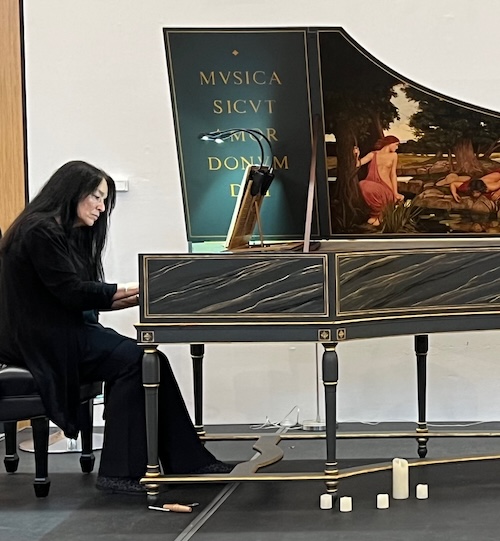
Harpsichordist Carole Cerasi performed a recital for Capriccio Baroque Thursday night at the French Embassy. Photo: CB
Capriccio Baroque is presenting its second Festival Capriccio this fall, beginning with two harpsichord concerts from Pierre Hantaï earlier this month and concluding with two more from Carole Cerasi.
The eminent latter harpsichordist played Johann Sebastian Bach works on Thursday night at the French Embassy, where she had to contend with more than just the challenges posed by Bach’s music.
The concert was held in a ballroom, not the auditorium usually used at the embassy, and its walls couldn’t keep out the noise of airplanes passing overhead—a frequent and unwelcome counterpoint that drew a couple rueful grins from Cerasi. At one point, a large bug crawled slowly on the white carpet in front of the stage, causing some discomfiture among nearby audience members. At another point, Cerasi had to take a break to fix her contact lenses; she told the audience she couldn’t see out of her right eye, posing particular difficulty as she was playing from scores.
It was hardly a wonder that Cerasi’s performances were somewhat uneven as a result. Nevertheless, she chose her program well, and the concert illuminated how Bach’s compositional style developed throughout his life.
The opening pair of pieces made an effective contrast. The Prelude, Fugue, and Allegro in E-flat Major (BWV 998), a late work, begins with a long rhapsody of arpeggios landing on bare notes in the bass, and Cerasi made the arpeggios feel like feathers aloft on a breeze. She switched on a dime to expertly limn the counterpoint in the fugue, giving the subject a particularly satisfying heft when it appeared in the bass, before closing on a brilliant Allegro.
Bach’s youthful writing in the Suite in A Major (BWV 832) had style and fluency to spare, but you could hear Bach working to fit his ideas into the received forms (rather than fitting the forms to his needs as in BWV 998). Cerasi gave a spirited performance, evoking the grandeur of brass in the “Air pour les trompettes” movement with bold, strutting chords and unspooling the melody graciously in the Sarabande.
In the Sonata in A Minor after Reincken (BWV 965), one of the transcriptions that Bach made of other composers’ works, Cerasi brought out the aspects that must have made Johann Adam Reincken’s Hortus musicus appeal to Bach, with another energetic fugue and stylish dance movements.
The high point of the concert was the Prelude and Fugue in A Minor (BWV 894), which Bach later adapted into a concerto for flute, violin, and harpsichord (BWV 1044). The Prelude features a blizzard of notes at dizzying speed, which Cerasi dispatched with thrilling ease; the Fugue demands all that and clear counterpoint as well, and Cerasi once again supplied the goods.
Other works proved less successful. A pair of chorale preludes from early and late in Bach’s life felt understated to the point of dullness. Contrapunctus I from the Art of Fugue sounded clean but lacked emotion, while Cerasi lost her place a few times in the hard-charging Contrapunctus VIII.
The concert concluded with one of Bach’s early Toccatas, the D Major (BWV 932), which features some rowdy dissonances and breathless runs up and down the keyboard — a young man testing the limits. Cerasi had a few more technical mishaps here but struck the right posture, neither overplaying nor underplaying the drama. The encore that followed, the Allemande from the French Suite in No. 4 in E-Flat Major (BWV 815), felt like a balm, even when a roaring jet engine threatened to drown out the coda.
Festival Capriccio concludes with Carole Cerasi performing French Baroque music written “For the Pleasure of the King” 8 p.m. Saturday at Live! at 10th and G. capricciobaroque.org
