A late maestro switch and an inspired violinist make for fresh, illuminating Beethoven with NSO
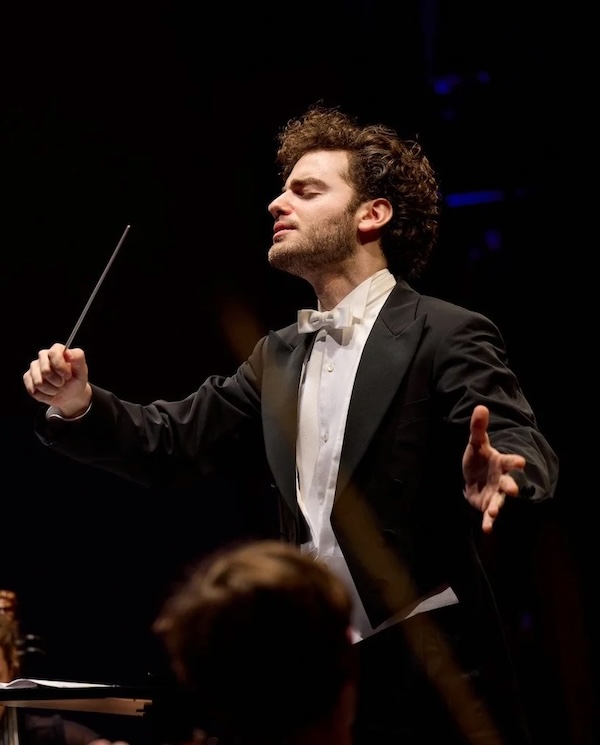
Emmanuel Tjeknavorian conducted the National Symphony Orchestra in an all-Beethoven program Thursday night at the Kennedy Center. File photo: Oliver Bochert
The National Symphony Orchestra concert on Thursday night was marked by some unexpected drama with an indisposed Christoph Eschenbach bowing out and the scheduled all-Beethoven concert led by Emmanuel Tjeknavorian in his place.
A prize-winning concert violinist, Tjeknavorian only started conducting three years ago. Nonetheless, the 30-year old Armenian-Austrian made an auspicious U.S. podium debut leading the NSO Thursday night at the Kennedy Center.
He clearly knows what he is about and he got the orchestra to play with verve, enthusiasm, and precision (aside from the not-quite-together unisons at the start of the Egmont Overture). He conducts mostly in phrases, rather than beats, and uses his left hand well for expressive effect. His podium movements are vigorous and to the point without being distracting. (His father, Loris Tjeknavorian was a noted composer and conductor.)
It is no small feat that Tjeknavorian got thrice-familiar Beethoven works—the Egmont Overture, and the Seventh Symphony—to sound fresh and vital (both conducted from memory to boot). The various orchestral choirs—strings, winds and brass—were consistently well-balanced, textures were transparent, and there was plenty of heft where needed.
Tjeknavorian artfully uses rests and is skillful with crescendos. The big buildup in the coda of the opening movement of the symphony was especially well gauged.
The finale of the symphony would have benefited from more abandon and there could have been more of a lamenting expression from the violins in the second movement, but these are matters of taste. The symphony throughout had the proper rollicking, up-on-its-toes feel that inspired Wagner’s felicitous description “the apotheosis of the dance.”
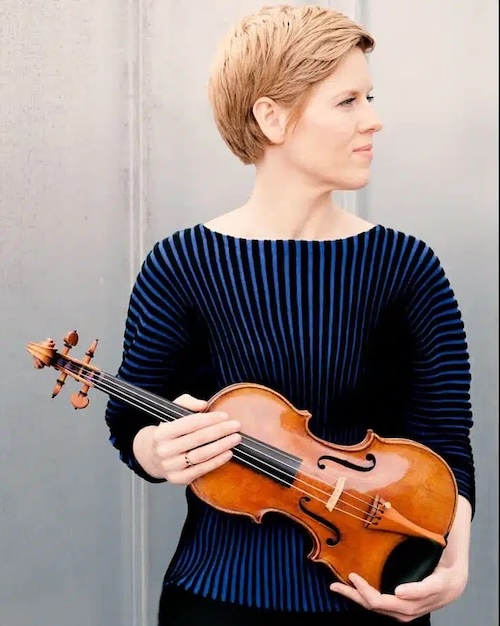
Isabelle Faust was the soloist in Beethoven’s Violin Concerto Thursday night.
Isabelle Faust was the evening’s soloist in Beethoven’s Violin Concerto. She has the complete package of seraphic top notes, impeccable intonation, free bow arm, faultless double stops and virtuosity to burn. (The ascending scale in fast thirds in an interpolated cadenza in the third movement was tossed off with ease.).
Passagework was never routine, but instead was impeccably phrased, and given melodic contour. She also wasn’t afraid to play with a vibrato-less tone, which is both stylistically appropriate and made the addition of vibrato a real event.
There were a few unusual features of the performance. The soloist played along with the first violins for extended passages in the tuttis of both outer movements of the concerto. She added cadenzas between the second and third movement, and in two spots within the third movement. And she utilized Beethoven’s oddball cadenza for the first movement (written for the piano arrangement of the concerto, and re-transcribed for violin), which includes participation by the timpani.
Tjeknavorian, who likely has performed the solo part, proved to be an estimable accompanist and the orchestra was with Faust at every point. She was able to play with an unforced sound, and to take plenty of well-chosen tempo fluctuations, without concern for balance or ensemble. Especially eloquent was the variation in the slow movement where strings play the theme pizzicato while the solo violin plays a celestial obligato. The whole movement in fact seemed to take place in suspended time, a tribute to both performer and orchestra.
One negative was the printed program, which failed to list individual movements of the concerto and symphony didn’t include opus numbers, and lacked the composer’s dates. There was also no mention of a substitute conductor, much less a biography. Someone needs to up their game.
The program will be repeated 8 p.m. Saturday and 3 p.m. Sunday. kennedy-center.org
One Response to “A late maestro switch and an inspired violinist make for fresh, illuminating Beethoven with NSO”
Leave a Comment



Posted Oct 17, 2025 at 11:43 am by Michael Klein
Excellent review! I was at the concert and had no idea of the change. I was shocked to see a new young conductor. I got no communications from NSO about the change. As a minimum an insert in the program or an announcement from the stage should have been the right thing to do.
The new program layout omits essential information that audiences have come to rely on: the presence (or absence) of intermissions, the duration of each piece, and — most importantly — the number of movements or parts within a work. This lack of clarity has caused confusion during performances, including instances of inappropriate applause between movements, which disrupts the experience for both audience and performers.
For years, the traditional program format offered clear, concise, and helpful guidance. I am genuinely puzzled by the rationale behind this new “innovative” approach, which seems to prioritize style over function.
I hope the NSO management reads these reviews and comments.