Hantaï brings panache to Handel suites in return to Festival Capriccio
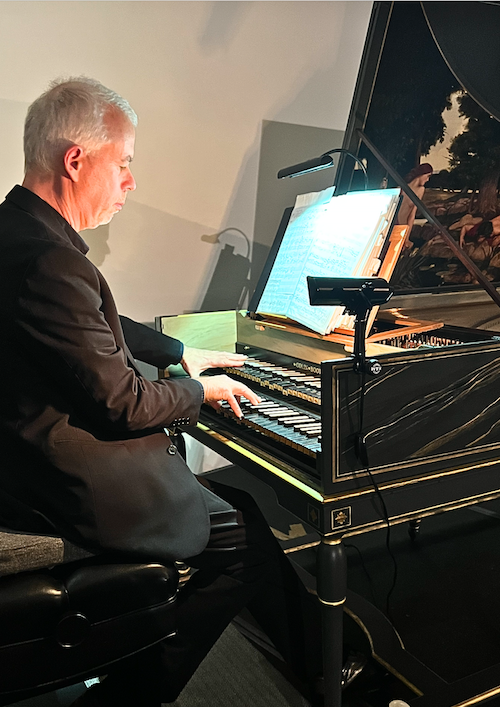
Pierre Hantaï opened Festival Capriccio with music of Handel Wednesday night at La Maison Française. Photo: CB
Festival Capriccio has returned for another year. The month-long celebration of the harpsichord, inaugurated by Capriccio Baroque last fall, opened Wednesday night with a concert devoted to Handel’s keyboard suites, performed by Pierre Hantaï.
The venue, the ballroom of La Maison Française, had the advantage of greater intimacy and a more resonant acoustic than the embassy’s auditorium, but regrettably with more passing jet noise from the flight path into Reagan National Airport.
The French harpsichordist, who also played two concerts in the middle of last year’s festival, returned this year as the headliner. In brief comments before this 90-minute program, played without intermission, he noted that two of the evening’s four suites were among the eight known as the “Great Suites.” The other two, cobbled together by Hantaï from various sources, while perhaps less striking in some ways, pleased nonetheless.
For his first manufactured suite, Hantaï took the last three of the five movements of Handel’s Suite No. 4, in E Minor, introduced by the Allemande from a later suite in the same key, HWV 438. To add variety to these dance forms, Hantaï took some of the many sectional repeats and omitted others. When he did observe a repeat, he often shifted the registration of the double-manual harpsichord (built by Colin Booth in 2011) to increase the sonic variety of the performance.
Hantaï enlivened the rhythmic flow of Handel’s music with rubato adjustments, especially in more improvisatory-style pieces, like the Prelude introducing the noble Suite No. 5, which he also played at one of his recitals in last year’s festival. After a melancholy Allemande and more vivacious Courante came the concluding Air and Variations, known by the much-later nickname “The Harmonious Blacksmith.” In the latter movement especially, Hantaï’s athletic, even forceful phrasing served as a reminder of the opera composer Handel’s dramatic side, particularly the later variations.
The second Hantaï compilation, mostly of pieces in D Minor, proved a more interesting set of works, not all dances. The opening movement, the multi-movement Overture from Handel’s opera Il Pastor Fido, featured a complex mix of rapid figuration and more contemplative slow sections. Hantaï moved from one musical character to the next with admirable fluidity. An Allemande and Courante, excerpted from two different later suites, worked surprisingly well as part of this sequence.
Of greatest musical interest in this set were Hantaï’s final three selections, beginning with a Larghetto movement that felt quite operatic in its baroque contrasts. An elegant Menuetto, exceeded in virtuosity by its three accompanying variations, then led to an unusual Gigue movement. Triplets rippled through both of the performer’s hands, one after the other, in this joyous perpetual motion piece in multiple sections.
Hantaï closed out the concert, which he again chose to play in relative darkness, with another of the “Great Suites,” Suite No. 3. Like the compilation suite before it, the minor key established an aura of dark contemplation. Hantaï thundered through the weighty prelude, leaning on the octave D that underpinned the opening figuration, taken with almost unmetered freedom. A solemn fugue then unfolded with cerebral austerity.
The Allemande and Courante sounded quite full, more contrapuntal and harmonically rich than some of the pieces not taken from the “Great Suites.” Hantaï gave the lavish ornamentation of the Air, a grand and stately dance, a florid extravagance. Handel provided this piece with five ornate Doubles, even more developed variations of the Air, which Hantaï played with abandon. Streams of sixteenth notes ran through the soprano voice, then the bass voice, and then in the middle of the two hands, followed by gigue-like triplets and a furious toccata.
The concluding Presto movement bristled with Italian virtuosity, reminiscent at times of a Scarlatti fandango, with an opening motif that returned throughout. Returning to the stage after warm ovations, Hantaï asked the audience, “How about some Bach?” Hearing general assent, he obliged with a crisply rendered Prelude from the English Suite No. 2, in the form of a concerto grosso with orchestral scope. A teaser, as it were, for his next performance in this welcome, now annual festival.
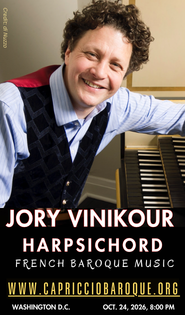
Festival Capriccio continues with a second recital by Pierre Hantaï, playing two of Bach’s English Suites, 8 p.m. October 18. capricciobaroque.org
Leave a Comment