Stradella’s baroque rarity given a lurid contemporary twist by IN Series
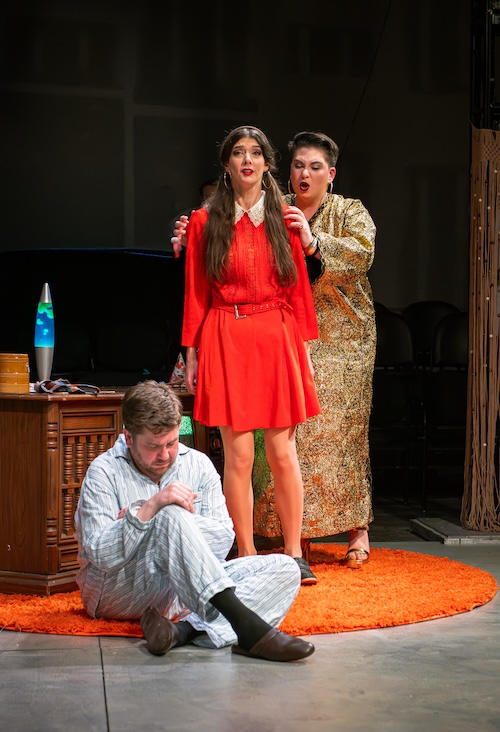
Dawna Rae Warren (center) with Andrew Adelsberger and Hayley Abramowitz in IN Series’ St. John the Baptist. Photo: Bayou Elom
IN Series opened a season of new works with a 17th-century Roman oratorio, retrofitted as an opera.
Timothy Nelson’s production of Alessandro Stradella’s gorgeous 1675 San Giovanni Battista, seen Friday evening, filled the pop-up black-box venue run by Theater Alliance in Southwest D.C. with outstanding music. The updating, through an English adaptation by Bari Biern and a 1970s staging co-produced with Catapult Opera, hearkened back to Nelson’s adventurous Ignoti Dei Opera company in Baltimore two decades ago.
An exemplary top of the cast proved the primary allure of this St. John the Baptist, as the company calls it. Soprano Dawna Rae Warren, a striking addition to the IN Series rotation in recent years, made a vocally virtuosic and splendidly acted Herodiade the Younger. (She is renamed Salome in this production, to underscore comparisons with the Wilde and Strauss adaptations of the same Biblical story.)
Warren’s showpieces in Part II highlighted the strength and agility of her voice. Manic runs soared up to a high B in “Deh, che più tardi,” and more athletic fury abounded as she delighted in her victory in “Sù coronatemi.” She also exquisitely phrased the slow lyricism of the poignant “Queste lagrime e sospiri,” with its twin violins in suspensions (leader Risa Browder and Keats Dieffenbach), all with laser-accurate intonation and placement.
No less searing was the more dramatic power of Hayley Abramowitz’s Herodiade, who drew upon her potent chest voice and brilliant top to bring the wronged queen to life. This casting worked especially well to highlight how Herod’s wife, insulted by the presence of the Baptist and his words against her, uses sheer force of will to deploy her daughter, presented as a flighty teenager in Warren’s rendition, against the prophet.
The title role suited countertenor Daniel Moody the best among his recent outings with IN Series. His voice, pure of intonation and intimate in scale, brought charisma and pathos to the character, who leaves his place preaching in the wilderness to come to Herod’s court with a surprising accusation. His moving aria “Io per me non cangerei,” sung while in the prison, showed off the plangent qualities of his singing, moving through the piece’s chromatic delights.
Bass-baritone Andrew Adelsberger made a dignified Herod with a center of hidden inner tragedy, although the role’s bottom notes felt light. Tenor Gregory Sliskovich used his voice to smarmy effect as the Counselor, a role repurposed in this adaptation as Herod’s brother, rather openly having an affair with Herodiade.
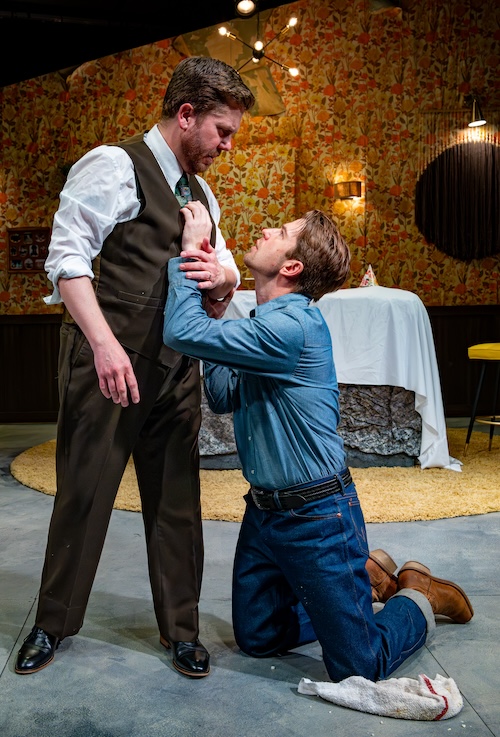
Andrew Adelsberger as Herod and Daniel Moody in the title role of IN Series’ St. John the Baptist. Photo: Bayou Elom
Nelson fielded an instrumental ensemble about half the size of the one that Stradella likely used, but all the parts were covered and the score did not feel cheated. Nelson himself conducted, standing at the harpsichord in the concertino group, which included cellist John Moran, the aforementioned violinists, and Cameron Welke providing diverting chordal figuration on theorbo and baroque guitar.
Nelson smartly enlisted Paula Maust to lead the ripieno (concerto grosso) part of the score, which she did alternating between a second harpsichord and baroque chamber organ. For the most part, Nelson relied on the musical acumen of his singers to hold things together, although his placement at the side sometimes caused slight ensemble misalignments, especially in fast numbers or during ritardandi.
To address the staging requires some spoilers at this point, so consider this your warning. Biern’s English adaptation has shifted the sexual undertones of the story from Herod’s unhealthy obsession with Salome to a homosexual liaison from his past. Because Moody’s St. John arrived in Herod’s household costumed as one of the Brokeback Mountain cowboys (costume design by Oana Botez), it was little surprise that he planted a kiss on Herod’s mouth.
Happily, this updating is no mere gimmick introduced for shock value. In Gerardo Ansaldi’s libretto for the oratorio, St. John goes willingly to Herod’s court and seems primarily motivated by the chance to save Herod from his shortcomings. The reorientation of the story also helped explain why Herod repents violently of offering any gift to Salome and regrets the prophet’s execution, carried out by the Counselor, so strongly.
The sets designed by Josh Sticklin evoke the garish interior of a decadent 1970s American home, with drug abuse, Ice Storm-style key parties, and other debaucheries that seems appropriately similar to Herod’s palace. A console combining an LP player and a television dominates the foreground, with carpets and decor in candy-bright colors. Lighting by Yannick Godts complemented the luridness of the setting, especially as Warren’s Salome, looking like a demented Wednesday Addams, went increasingly off the rails.
St. John the Baptist runs through October 5 at Theater Alliance, with a subsequent run at Baltimore Theatre Project October 10 to 12. inseries.org