Pantomime trumps dance in theatrical “Hamlet” at Wolf Trap
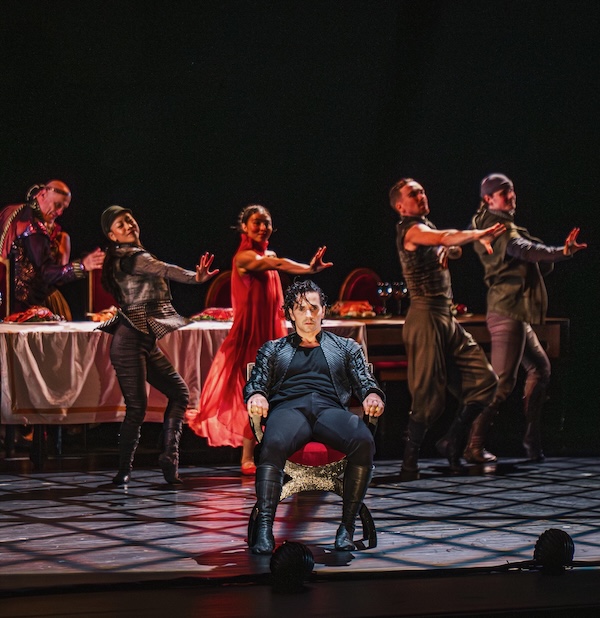
Guillaume Côté (center) in the title role of “The Tragedy of Hamlet,” presented by Ex Machina at Wolf Trap. Photo: Rei Linam/Wolf Trap
In a dance performance, choreography usually takes center stage. In a growing corner of the modern dance world, however, directors and choreographers are accentuating theatrical effects to make a sort of hybrid genre.
Such is the case with the Tragedy of Hamlet, premiered last year in Toronto by theater company Ex Machina and modern dance company Côté Danse. The presenters brought the piece for a single performance to the Filene Center at Wolf Trap Wednesday night.
The work’s lighting and special effects were of sufficient importance to require a late start time of 8:30 p.m. in the venue’s outdoor theater. Robert Lepage, founder of Ex Machina in Québec City, is perhaps best known in the United States for his expensive, technologically ambitious production of Wagner’s Der Ring des Nibelungen for the Metropolitan Opera. In this adaptation, the director streamlined Shakespeare’s most famous play, making some significant changes.
The theatrical aspects of the work made the strongest impact. Much of the production involved the interplay of light and shadow, thanks to stage-spanning swaths of blood-red curtain and strategically placed uplighting. The lurid, often vertiginous effects, including a rapid strobe light at one point, giving a visceral sense of something being rotten in Denmark.
Two scenes stood out for the ingenuity of Lepage’s vision. Hamlet saw the ghost of the murdered king arising from his tomb, rather than on the ramparts of the castle. Without words, the ghost acted out a mute show of his own assassination, silhouetted against a large white shroud that rose up in front of a bright light. Shadowy figures created by the dancers played out the chilling scene, often growing to menacing size.
Even more remarkable was the suicide of Ophelia, played with long-limbed innocence by Miyeko Ferguson. A large silken cloth, lit a cool blue, served as the water in which she drowned, held and lifted by unseen dancers’ hands. This watery scrim then served, with marine sound effects, as the ocean on which the ship carrying Hamlet steered its way toward England. As Ophelia flung herself at Hamlet earlier in the production, she seemed to flow off his back like water, extending the aquatic association.
Guillaume Côté, costumed by Michael Gianfrancesco mostly in moody black, made Hamlet seem more inclined to rash action than held back by his own doubts. The most famous of the melancholy Dane’s soliloquies, “To be or not to be,” was alluded to by the momentary placing of his sword to his own throat. Casting Horatio as a diminutive female dancer, the spritely Natasha Poon Woo, gave their interactions a playful quality, as Côté flung Woo about the stage, frequently lifting and carrying her in an agitated fashion.
A general emphasis on pantomime distinguished the characters from one another throughout the compact 100-minute evening (without intermission). Lukas Malkowski gave Laertes a strong physical presence, and Michel Faigaux’s Polonius, always with a domineering staff in hand, radiated pompous self-absorption. Both characters exerted their control over Ferguson’s Ophelia with the visual language of constraint. Laertes dragging Ophelia into her grave with himself proved the final confirmation of a disturbing family dynamic.
Sonia Rodriguez’s Gertrude receded into the background except for her startling bedroom argument with Hamlet. Threatening her son with a sword led to the murder of Polonius, who was hiding under the bed rather than behind an arras. The bald figure of Claudius was played with threatening presence by Robert Glumbek. The Rosencrantz and Guildenstern of Jake Poloz and Willem Sadler, respectively, provided welcome comic relief, costumed as dopey twins and generally moving absurdly in tandem.
Restrictions imposed by the small cast of just nine dancers mandated creative solutions to some scenes, like the play within the play. Lepage and Côté had Hamlet and Horatio reenact the murder, dancing in eerie masks and with their backs to the court. Likewise, the pageantry of the Danish court came down to most of the cast dancing some vaguely court-like numbers, with frantic hand motions, and the graveyard scene featured no caustic commentary from the gravediggers, just a skull that Hamlet danced with briefly.
Genuine dance and traditional choreography played no more than a minor role in the production. The prerecorded score composed by John Gzowski added little. A mix of electronic distortion, folk-like elements, electric guitar, and synthesized harpsichord reached for a grab bag of cultural references and historical eras. Often reduced to two or three parts, the score’s minimalistic bent proved long on volume and short on interest.
Mezzo-soprano Anne Sofie von Otter and pianist Kristian Bezuidenhout perform an evening of Schubert to open the Chamber Music at the Barns series, 7:30 p.m. October 9. wolftrap.org